Short answer: lettuce, leafy greens and brassica seedlings through the cool months, then tomatoes, capsicums and cucumbers from an early spring start into autumn. A greenhouse does not make every crop grow all year; it lets you run two seasons back to back, while your climate zone decides which of the two is the hard one.
If that is all you needed, the table further down sets out the timing by climate. The sections before it explain why the cool season suits leafy crops, when to start the summer crops under cover and what changes in the tropics.
What grows in a greenhouse through an Australian winter?
Leafy crops, mostly, because they prefer the cool. Applied Horticultural Research puts the suitable air temperature for lettuce at 12 to 21 degrees, with 18 degrees the optimum. That is a cool-season range, which is why lettuce fills the winter greenhouse rather than the summer one.
In cool climates, Peter Cundall's year-round planting guide for Tasmanian and cool-climate conditions, published by ABC Hobart, plants or sows winter lettuce, silverbeet, English spinach, broad beans and Asian greens from March through May. In June it sows cabbage, cauliflower and broccoli in containers under glass or indoors, raising seedlings to plant out in August.
That is the winter job a greenhouse does best: a sheltered bench full of seedling trays while the garden beds are cold, so the spring planting starts with sturdy plants rather than seed.
When should the summer crops start?
Earlier than outdoors, which is the whole point of the greenhouse. Gardening Australia's Hannah Moloney says gardeners in the cooler, southern parts of Australia need to start tomatoes, capsicums and eggplant from seed any time from mid to late winter, with the trays somewhere warm such as a sunny windowsill or a little hothouse. The seed should take 7 to 10 days to germinate.
Peter Cundall's guide runs a little later: it sows tomatoes under glass in September, then cucumber, eggplant, capsicum and more tomatoes under glass or in containers in October, with tomato seedlings planted out towards the end of October. Yates, the seed company, takes a similar line in its tomato growing guide: in temperate, cool and cold climates, sow from spring, or sow indoors in late winter and transplant once the risk of frost has passed.
The difference between those dates comes down to warmth and frost. Queensland Department of Agriculture and Fisheries horticulturists put the optimum for tomato germination at 20 to 30 degrees, decreasing rapidly below 15 degrees; light frosts kill the tops of the plants and heavy frosts kill them outright. A greenhouse bench is the sheltered, warmer spot all three sources describe.
What changes in the subtropics and tropics?
In the tropics and subtropics, the difficult season flips from winter to summer. Yates says tomatoes in tropical and subtropical climates can be grown all year round but are best in autumn and winter, during the dry season. Its capsicum guide says tropical capsicums do best in the dry season because they are prone to fungal problems in the wet; its cucumber guide plants tropical cucumbers from late summer to early spring to avoid the wet season and moisture-loving diseases such as powdery mildew.
Temperature compounds the difficulty. The same Queensland thresholds show tomato fruit setting reduced once temperatures rise above 27 degrees, so in the north the greenhouse's summer job is shade and airflow rather than warmth. Our guide on whether greenhouses are too hot in summer covers the vents and shade cloth that make that possible.
| Crop |
Cool climate (Peter Cundall, ABC Hobart) |
Tropical and subtropical (Yates) |
| Tomato |
Sow under glass in September and October; plant seedlings from late October |
All year; best in autumn and winter, the dry season |
| Capsicum |
Sow under glass in October; plant seedlings in November and December |
Tropics: any time, best in the dry season. Subtropics: early spring, once the danger of frost has passed |
| Cucumber |
Sow under glass in October; plant seedlings in November and December |
Tropics: late summer to early spring. Subtropics: from mid-winter |
| Lettuce |
Winter lettuce planted March to May; seedlings again from August |
All year, depending on variety and location |
The lettuce row for warm climates comes from Yates' lettuce guide, which lists it as all year round depending on variety and location. Check the seed packet for the variety you are sowing, since timing shifts with it.
Does a greenhouse need heating to fruit through winter?
In a cool climate, yes. The Queensland thresholds are plain: tomato fruit setting is reduced once temperatures fall below 10 degrees. Fruiting crops through a Tasmanian, alpine or inland winter need a heat source, such as the Winter Gardenz Electric Fan Heater 2.4kW, running on cold nights.
Here is the honest trade-off. Heating costs money for months; for most households the better plan is to run the greenhouse unheated through winter for greens and seedlings, then save the fruiting crops for spring. Ring Hayden on 1300 515 620 if you are weighing it up; he will tell you when a heater earns its keep and when it does not.
What else does a year-round greenhouse need?
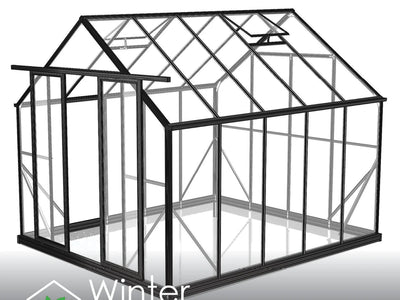
A structure that lasts through every season you ask of it. Winter Gardenz says its polycarbonate greenhouses use UV-blocking 6mm twin-wall panels backed by a 10-year warranty. Plastic film is the weak point by comparison: NSW DPIRD advises that plastic coverings need to be replaced routinely, before they visibly start to break down. Our polycarbonate greenhouse buying guide compares the options.
Three other decisions shape a year-round greenhouse; each has its own detailed guide. Winter sun sits low, so the site matters: see whether a greenhouse should go in sun or shade. The frame needs level, solid ground: see the best base to put a greenhouse on. Some crops simply do better in an open bed: see what plants should not go in a greenhouse.
Seedling trays need bench space through winter, which is where the Winter Gardenz 3-Tier Greenhouse Shelving earns its place. Every greenhouse we range comes with our price-beat promise and owner's after-care: a fit check before it ships, a shepherded delivery and a check-in within a week. We also handle any warranty claim for you. Browse the full range of greenhouses and greenhouse accessories, or ring Hayden on 1300 515 620.
You May Also Like:
About the author:
“I have a real passion for helping transform outdoor spaces so people can relax, connect and entertain with confidence and pride. With My Acre, I love guiding homeowners to create beautiful and functional outdoor living areas."