Buying guide
Own one already? Fire pit covers and cover plates are sorted by the model they fit.
Which ethanol fire pit suits your space
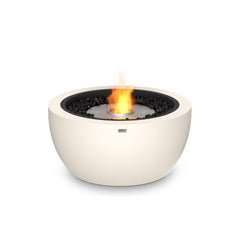
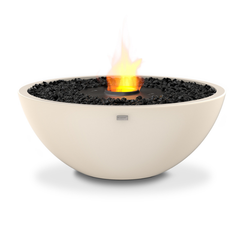
For a balcony or small courtyard the Mix 600 (from $1,295) is the pick, warming about 20 m². For a large terrace the Pod 40 (from $2,695) gives the most presence, warming about 60 m². For a covered or indoor alfresco area, choose the Pod 30 (from $1,995) or Pod 40, the two fire pits EcoSmart rate for indoor use with the right parts.
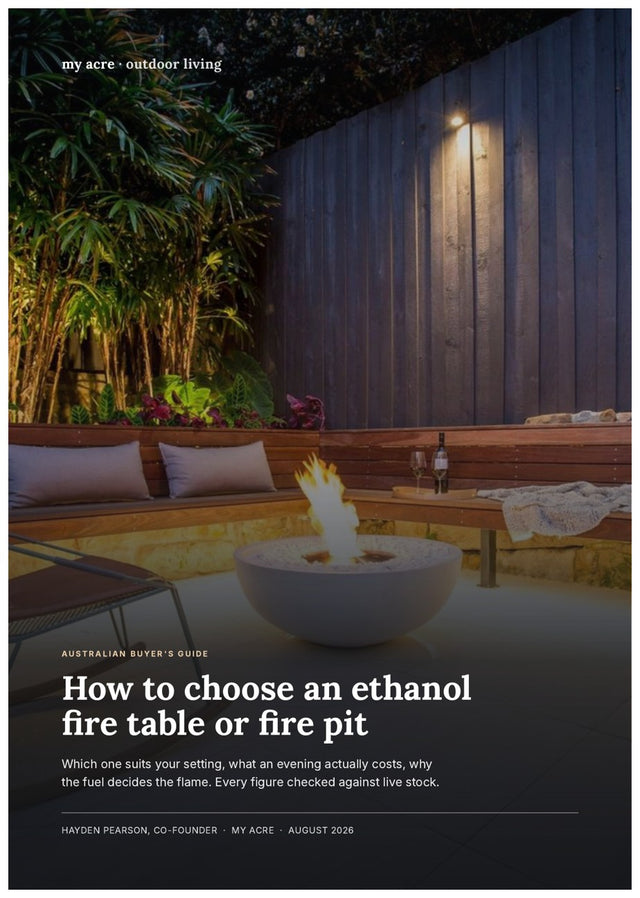
Freestanding ethanol fire pits from EcoSmart Fire, also sold as bioethanol fire pits, that burn clean e-NRG fuel with no smoke, flue or gas line. They suit considered courtyards, decks and pool terraces where a built-in fireplace is neither practical nor wanted.
Compare all five EcoSmart fire pits
| Model | Price from | Burner | Heats | Use | Size | Best for |
|---|
| EcoSmart Mix 600 | $1,295 | AB3, 2 kW | About 20 m² | Outdoor | 600 mm bowl, 229 mm high | Balconies and small courtyards |
|---|
| EcoSmart Stix | $1,795 | AB3, 2 kW | About 20 m² | Outdoor (see note) | 780 mm tall stainless frame | A sculptural piece on a small footprint |
|---|
| EcoSmart Mix 850 | $1,895 | AB8, 6 kW | About 60 m² | Outdoor | 850 mm bowl, 319 mm high | Open patios and larger groups |
|---|
| EcoSmart Pod 30 | $1,995 | AB8, 6 kW | About 60 m² | Indoor or outdoor* | 762 mm bowl, 351 mm high | Covered alfresco areas |
|---|
| EcoSmart Pod 40 | $2,695 | AB8, 6 kW | About 60 m² | Indoor or outdoor* | 1,000 mm bowl, 504 mm high | Large terraces |
|---|
Choose by space: balcony or small courtyard, the Mix 600 or Stix; open patio, the Mix 850; covered or indoor alfresco, the Pod 30 or Pod 40. Heat and burner figures are EcoSmart's. *Indoors, the Pod 30 and Pod 40 need the Indoor Safety Tray ($200, sold separately) and the AB8 Efficiency Ring. EcoSmart lists the Stix as outdoor, so call us before you plan it inside.
Ethanol fire pit prices and delivery
EcoSmart ethanol fire pits run from $1,295 for the Mix 600 to $2,695 for the Pod 40, in the cheapest finish. Bone with a stainless burner is the starting price on the concrete bowls; black burners cost a little more. Delivery is free Australia-wide, with a 30 day home trial on every EcoSmart fire. We will beat any genuine lower price from an Australian stockist.
Warranty follows EcoSmart's policy: 2 years on the burner and stainless steel parts, 1 year on the concrete bowl and glass. My Acre lodges and manages any claim for you. Prices and delivery as at September 2026.
Ethanol or bioethanol: why there is no smoke
Ethanol and bioethanol fire pits are the same thing. The fuel is a plant-based ethanol, so the words are used interchangeably. EcoSmart burners run on e-NRG, the fuel EcoSmart formulate and test for them. It burns as a clean flame, which EcoSmart describe as smokeless, with no soot or ash to sweep out. That is why a bioethanol pit can sit where a wood fire would smoke out the neighbours. If you are weighing it against wood, our smokeless fire pit guide sets out the trade-offs honestly.
Running cost and burn time
Fuel is the running cost. At current e-NRG prices of $6.30 to $6.88 a litre delivered, the Mix 600 and Stix (AB3 burner, 0.31 L an hour at full flame) cost about $2 an hour. The Mix 850, Pod 30 and Pod 40 (AB8 burner, 1.1 L an hour) cost about $7 to $7.60 an hour. An AB3 holds 2.5 L and runs 8 to 11 hours; an AB8 holds 8 L and runs 7 to 9 hours. See e-NRG bioethanol fuel for carton pricing.
Want the flame built into your own bench or table instead? See our fire pit kits. For a flame with a tabletop around it, see our fire pit tables. For wood-burning options, browse the full outdoor fire pits range.
Frequently asked questions
Tap a question to read the answer.
Are bioethanol fire pits worth it?
Yes, for the right job. A bioethanol fire pit gives a real flame with no smoke, flue or gas line, so it works in a courtyard or on a terrace where a built-in fireplace is not practical. Treat it as a focal point and zone warmth for the people around it, not as heating for a whole yard.
Is an ethanol fire pit the same as a bioethanol fire pit?
Yes. Both names describe a fire pit that burns liquid ethanol made from plants. EcoSmart call their fuel bioethanol; many buyers search for ethanol fire pits. Every model on this page is the same kind of burner in a concrete or stainless surround.
Are ethanol fire pits legal in Australia?
They are sold and used across Australia, but rules on open flames differ by state and council. A total fire ban can apply to any open flame. Check with your local council or fire authority before lighting one on a ban day. Our guide to fire pit rules by state links each authority.
Are bioethanol fire pits safe?
Yes, when set up and refuelled to EcoSmart's instructions. Place the pit on a level, stable base with the clearances in its installation manual. Never refuel while the burner is lit or hot: put the flame out, let it cool for at least 60 minutes, then refill with the supplied safety spout.
How long does a fill last?
The Mix 600 and Stix hold 2.5 L and run about 8 to 11 hours. The Mix 850, Pod 30 and Pod 40 hold 8 L and run about 7 to 9 hours. EcoSmart give these as full-tank figures; wind and conditions shorten them.
Can you use a bioethanol fire pit indoors?
Only the Pod 30 and Pod 40 are rated by EcoSmart for indoor use. Both need the Indoor Safety Tray and the AB8 Efficiency Ring fitted, in a room of at least 116 m³. The Mix 600 and Mix 850 are outdoor models.
Can I use one on a timber deck or near a pool?
EcoSmart show these pits on pool decks and patios. Follow the model's installation manual for the base and clearances. For composite boards, read our guide to fire pits on composite decks first.
What fuel do they use?
e-NRG bioethanol, which EcoSmart formulate and test for their burners. We do not recommend substitutes such as methylated spirits, gel fuel or untested bioethanol in these burners.
What are the disadvantages of an ethanol fire pit?
There are three worth knowing before you buy. It is not primary heating: expect warmth across about 20 m² on the small models and 60 m² on the large ones. The fuel is the running cost, about $2 an hour on the Mix 600 and Stix and about $7 on the others. You also cannot top up a hot burner, so plan the evening around a full tank.
Not sure which suits your space? Call Hayden on 1300 515 620 or send us a message. Every EcoSmart fire comes with free delivery Australia-wide, a 30 day home trial and our price beat promise.