Lisa B
★★★★★
10 Nov 2026Great customer service - they rang me to tell me exactly when my bbq was coming, they also sent over the instructions and price honoured me. 10/10.
Price beat promise

Most chosen
Not sure which one?
Hayden, co-owner
Tell me about your space and I will point you to the right fire. I reply the same business day.
Call 03 7073 2116Most chosen
Not sure which one?
Hayden, co-owner
Tell me what you love to cook and I will point you to the right setup. I reply the same business day.
Call 03 7073 2116Most chosen
Not sure which one?
Hayden, co-owner
Tell me the area you want to shade and I will point you to the right size. I reply the same business day.
Call 03 7073 2116Ponds and fountains
FountainsPondless waterfallsPond kitsDam aerators and fountainsPond filters and equipmentPool care
Robotic pool cleanersBrands
AquascapeAtlas FiltriBBA BiosolutionBeatbotBiancoClayTechDAB PumpsElevateKellockOaseOtterbinePietro StonewareRobo-TekWater MasterNot sure which one?
Hayden, co-owner
Tell me what you need the water to do and I will point you to the right pump, filter or water feature. I reply the same business day.
Call 03 7073 2116Where to start
Not sure which one?
Hayden, co-owner
Tell me what you are planning and I will point you to the right fit. I reply the same business day.
Call 03 7073 2116Spas
Spas and hot tubsComingSwim spasComingNot sure which one?
Hayden, co-owner
Tell me how you want to relax and I will point you to the right spa or sauna. I reply the same business day.
Call 03 7073 2116Not sure which one?
Hayden, co-owner
Tell me what you are planning and I will point you to the maker that suits it. I reply the same business day.
Call 03 7073 2116
Fire
Most chosen
Outdoor Kitchens
Most chosen
Shade
Most chosen
Water
Ponds and fountains
FountainsPondless waterfallsPond kitsDam aerators and fountainsPond filters and equipmentPool care
Robotic pool cleanersGarden
Where to start
Spas & Saunas
Spas
Spas and hot tubsComingSwim spasComingBrands
About
Who we are
Who is My Acre?Why My Acre?Meet Hayden and TimOur installersContact usWhat we promise
Price beat promiseShipping and deliveryWarranty and claimsReturns and exchangeGuides and resources
Customer resourcesCustomer reviewsBlogs


Short answer: Fix the base to something that cannot move, brace the frame, then stop the wind getting inside. Winter Gardenz say corner stakes alone are not suitable for a site exposed to strong winds. There, the greenhouse should be bolted to a concrete or timber footing with a mounting kit that fixes at 12 points, with roof and eave braces added before storm season.
That is the whole method for the polycarbonate greenhouses we stock. The sections below explain each step, what the wind numbers in a forecast mean for a greenhouse and why owners lose panels outwards rather than inwards.
No kit greenhouse is windproof; we would not tell you otherwise. Winter Gardenz describe their glasshouses as built for 150 km/h wind resistance to prevent panel blowouts, yet the standard polycarbonate greenhouse pages say only that the structure is engineered for high wind zones. Either way, the real answer depends on how securely the greenhouse is fixed down.
Forecast figures need care. The Royal Meteorological Society's Beaufort scale table puts a near gale at 50 to 61 km/h, when whole trees move. A strong gale runs at 75 to 88 km/h, when slight structural damage begins. Those speeds are 10-minute averages measured 10 metres up, so they do not capture the sudden bursts that strip panels from a greenhouse in high winds.
Owner reports show where the limit sits for lightweight kits. One gardener on Permies watched aluminium members crack and tear in gusts above 65 mph, about 105 km/h, with panels falling out everywhere. A frame bolted to a footing is the best protection a garden greenhouse has against that kind of damage.

A level, square foundation that you build before the kit arrives. Winter Gardenz's foundation information explains that the greenhouse base is an aluminium frame 40 mm wide and 80 mm tall, while the customer provides the foundation beneath it: a concrete slab, a nib wall or stakes.
For a large greenhouse or soft ground, the maker's foundation guide recommends a concrete footing about 300 mm wide and 400 mm deep, strongly recommending one for extension models of 16 feet or longer. It also suggests a professional concreter, because accuracy of level and square matters. Our guide to what a greenhouse should sit on compares slabs, gravel and timber in more detail.
Match the fixing to how exposed the site is, because Winter Gardenz supply different fixings by size; the table below sets out the three options in their guide.
| Fixing | Supplied with | Suits |
|---|---|---|
| 300 mm corner stakes in soil | 6ft and 8ft wide, up to 12ft long | Sheltered sites only |
| Corner stakes concreted in | Same models | A stronger anchor |
| Mounting kit to concrete or timber | All 10ft wide and 16ft plus models | Windy or exposed sites |
For the smaller sizes, Winter Gardenz sell the foundation mounting kit separately, in flush or surface versions that attach at 12 locations around the base. The order of work matters:
The maker's own words on stakes alone are blunt: quick, simple and easy to move later, but not suitable if your site is exposed to strong winds.
Brace the structure, then shelter it from the prevailing winds. Winter Gardenz sell a B02 eave brace that they highly recommend for coastal, rural and cyclone-prone regions, alongside a B01 roof brace recommended for any size in a high-wind zone.
Both braces come as standard on models with a single run length of 10 feet or longer, according to the maker; shorter models need them added. Positioning helps too: Winter Gardenz's siting advice suggests shielding the greenhouse from prevailing winds with a windbreak of posts and trellis or wind cloth. The same page asks for at least 1 metre of clearance on every side.

A heavy frame fixed to a footing, with its glazing held firmly and its doors shut. The worst outcomes in owner reports come from lightweight plastic-covered greenhouses: one viewer of a storm-proofing video watched a new plastic greenhouse destroy itself in the first breeze, despite a sheltered corner.
Others secure plastic greenhouses with sandbags, bricks or screw-in anchors after a first failure. Glass is not the answer to wind on its own, either: Winter Gardenz glaze their standard greenhouses in 6 mm twin-wall polycarbonate and their glasshouses in 4 mm toughened glass. The maker notes that the B01 roof brace helps carry the weight of heavy glass panes overhead.
In both greenhouses, the glazing is only as secure as the fixings holding it. That is why the anchoring and bracing steps above matter more than the choice of sheet, particularly for plants you cannot afford to lose to one bad night of weather.
Most advice focuses on anchoring; owners describe a different failure. On the Hardy Tropicals forum one grower found several polycarbonate panels cleanly blown out of the frame, with the wind apparently getting under the base and pushing outwards.
A member of Gardeners Corner made the same point bluntly: for panes to blow out, the wind must be getting inside, because the clips are not designed to stop them moving outwards. On Houzz owners of a clip-glazed kit describe panels bowing until they escape, then fixing them with screws and washers, extra clips or sealant. Others run tape along the glazing to keep it seated in the channels during bad weather.
The practical lesson is to keep the wind outside the greenhouse. Close and latch the door and roof vents before a storm, then check that the gap along the bottom rail is sealed so the wind cannot get in underneath. One owner wondered afterwards whether a partly open door would have eased the pressure, but that was one voice; two owners in a YouTube comment thread credit keeping theirs closed.
Treat a forecast strong gale as a job list rather than a worry, since a few minutes of preparation before storms arrive protects a greenhouse worth several thousand dollars. The plants inside benefit as much as the glazing.
Replacing a single panel is a small job; replacing a frame that has lifted off its footing is not, which is why the fixing matters more than anything else on this list.
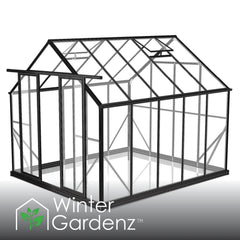
The Winter Gardenz 6ft Wide Polycarbonate Greenhouse and the 8ft wide models arrive with corner stakes up to 12 feet long. Longer models and every Winter Gardenz 10ft Wide Polycarbonate Greenhouse include surface mounting brackets. If your site is exposed, plan the footing, mounting kit and braces into the budget from the start.
Our price-beat promise applies to every greenhouse we sell, with owner's after-care that includes a check-in within a week of delivery; we also handle any warranty claim for you. Ring me on 03 7073 2116 before you order, describe your site and I will confirm which fixings your size includes.

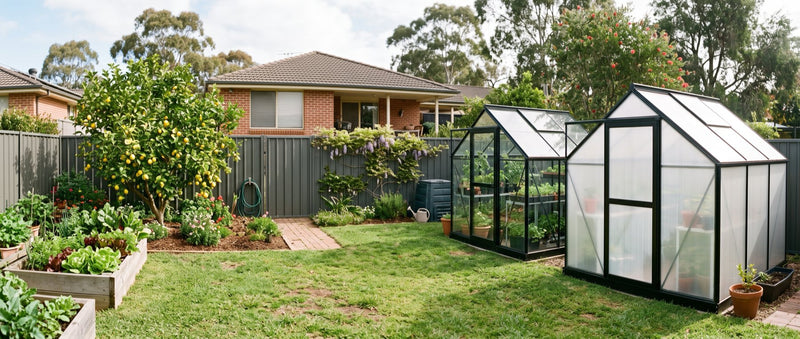 Greenhouses
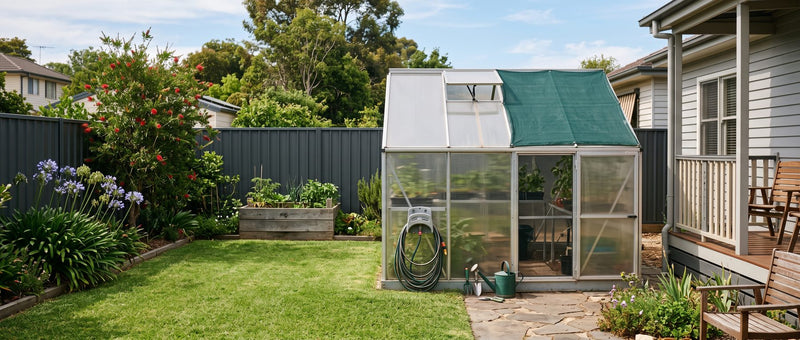 Greenhouses
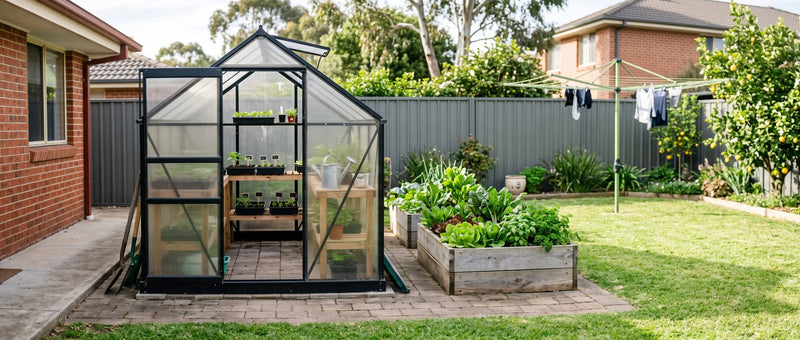 Greenhouses

Want a written quote?
Tell me what you are after. I send it the same business day.
Great customer service - they rang me to tell me exactly when my bbq was coming, they also sent over the instructions and price honoured me. 10/10.
Great table delivered quickly! Very happy
We recently had a Serenity Cantilever umbrella installed and the My Acre team were fabulous. From initially advising us what would suit our tricky terrace best, to keeping us informed on delivery and installation and ...
Really happy with my Shadowspec Retreat wall-mounted umbrella. Hayden at My Acre has been great — always quick to respond and very helpful. I recently needed to make a small warranty claim, and Hayden organised everyt...
Thanks to the My Acre team delighted with the end product of the Umbrella cantilever shade. In all respects Hayden was fantastic details, invoicing, adjusting delivery to suit us and supporting the installation with a...
Australian owned · every order personally followed up