Short answer: Yes, with a weighted free-standing base, which is the only mount that works on artificial grass without cutting into it. Nothing can be bolted to synthetic turf, because turf is a surface finish laid over a compacted aggregate base rather than a structure. Expect the pile under the base to flatten and the infill to shift.
That answers the question, so anyone who only needed the yes can stop reading here. What follows is the part we find the turf pages and the umbrella pages both skip, which is what happens where the two meet.
Can you put an outdoor umbrella on artificial grass?
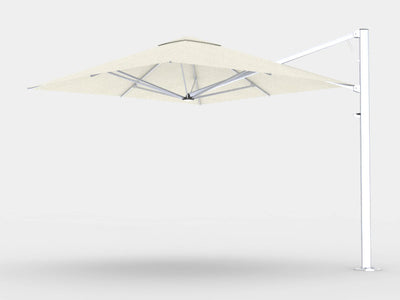
Yes, and the mount decides everything. A cantilever umbrella comes with four possible mounts, listed on the Shadowspec installation base page: a free-standing base, an in-ground anchor, a surface plate and a wall bracket. Only one of the four stands on turf as it is.
The free-standing base works because it asks nothing of the ground beyond being flat and firm, while the in-ground anchor also works but only at the cost of cutting your turf open. The surface plate needs something structural to bolt into, which artificial grass emphatically is not; the wall bracket ignores the ground altogether.
Our practical answer on a synthetic lawn, then, is a ballasted base, or a hole cut through to a footing, or a wall.
What is actually under your artificial grass?
Crushed rock, which is the part actually doing the structural work. A properly built synthetic lawn is closer to an engineered pavement with a green finish than to a carpet thrown over dirt.
The AusGrass artificial grass installation guide sets out the standard Australian build: excavate to around 100mm from the lowest finished edge, lay and compact a minimum 70mm crushed rock layer, spread and compact stone dust over it, then finish the base roughly 10mm to 20mm below the surrounding edge before the turf goes down. Kiln-dried sand is brushed into the pile afterwards to hold the blades upright.
That build specification is why a heavy umbrella base is not a structural problem on turf: roughly 164 kg of ballast, which is what the 12 concrete pavers in Shadowspec's free-standing base weigh together, is landing on compacted crushed rock rather than on anything soft.
Turf laid straight onto soil is an entirely different story, so it is worth establishing which of the two you have before ordering a 164 kg base. Where the installer excavated and compacted properly, your base will sit level for years; where the turf was simply rolled out over an existing lawn, it will not.
What happens to the turf under the base?
The pile flattens and the sand infill migrates, neither of which is dramatic, though both are permanent enough to matter on the day your umbrella eventually shifts position.
Two things are happening at once here. The synthetic blades are held upright by kiln-dried sand infill, so sustained weight pushes that infill downwards and sideways while the blades themselves bend over and stay bent, leaving a pale matted square in the exact shape of the base.
Contact area matters more than total weight here, which is simply pressure at work. A cross-frame base spreads its 164 kg across most of a square metre, while four narrow feet carrying the same load press it into a few square centimetres each. Narrow feet therefore mark turf much faster than a heavier base with a wide footprint.
Light matting brushes back up with a stiff broom and a top-up of kiln-dried sand, whereas deep compaction after several seasons in one position never fully recovers. Shadowspec sells stainless steel castor wheels for the free-standing base. On turf we think they earn their place twice over, because shifting the base a few centimetres each season is the whole of the prevention strategy.
What can I put on top of artificial grass?
Anything with a broad, flat and reasonably smooth base. Umbrella bases, planters standing on feet, outdoor settings with wide glides and the cross frames of cantilever umbrellas all sit on synthetic turf without any trouble at all.
What causes damage is a narrow bearing point, a sharp edge, or anything at all that traps water against the backing, because the turf backing is perforated for drainage. A solid rubber mat or a rubber-backed outdoor rug placed under a base will hold moisture underneath it rather than letting the rain pass through.
If you want a protective layer under a heavy base, a permeable one is the only version that works, since anything sealed simply relocates the problem rather than solving it.
What not to put on artificial grass
Anything that blocks drainage, and anything carrying a spike. Those are the two failure modes worth planning around, of which the first is considerably more expensive than the second.
The drainage point is not theoretical on a balcony. Answering a question on Bunnings Workshop about what to lay under artificial grass on a tiled balcony, a Bunnings team member warned that whatever goes down must not block or slow water reaching the existing drains. In heavy rain, even a small obstruction can cause water to pond and back up toward door thresholds and into the apartment.
Put a 164 kg umbrella base, plus underlay, plus turf on a balcony and the warning above is describing your balcony specifically. Identify exactly where the drains sit before anything is laid, then keep the base and its shadow well clear of them.
Spikes and ground augers are the other failure mode. Umbrella stands that anchor with a spiral auger driven into soil will punch straight through the turf backing; repeated staking in one position tears that backing and spills the infill through it. Those stands were designed for natural lawns rather than synthetic ones.
Ring us on 1300 515 620 before you commit to a mount on turf. Tell us what is under the grass and how the area drains. We will tell you whether a ballasted base is enough or whether the job wants a footing.
Can an umbrella be fixed through artificial grass?
Yes, into whatever sits underneath it, and into nothing else. Two versions of this arrangement work in practice.
Where the turf sits on a compacted base, an in-ground anchor is the answer. Shadowspec describes the in-ground anchor as the option for locations where a hole can be dug and supplies preparation instructions with the order. In practice that means cutting the turf, excavating through the crushed rock, pouring a footing, curing it, then trimming the turf back neatly around the finished fitting.
Where the turf sits over concrete, which is common on courtyards and balconies, the surface plate becomes possible again. The fixings pass through the turf into the slab beneath, so the slab does the work. Shelta's cantilever installation guidance is specific about what a slab has to be for this: 110mm to 120mm of reinforced concrete, with 100 x 8mm minimum expansion or chemical anchors, preferably stainless where salt or chlorine is nearby.
What never works is fixing to the turf itself, because U-pins and turf nails are designed to hold a lawn down against its own edges. They resist nothing remotely like the overturning force of an open cantilever canopy.
Is a ballasted base enough on turf?
Usually, with one honest caveat. Shelta, which manufactures cantilever umbrellas in Australia, states plainly that nothing will be as good as the bolt-down method, because all of its wind testing is done bolted down.
On artificial grass most owners will still choose the base, because the alternative involves cutting a hole in a lawn that was installed precisely to look unbroken. We think that is a perfectly reasonable trade, provided you make it knowing that a ballasted base stays the compromise option in wind rather than the equal of a fixed one.
The wind limit itself does not move. Shadowspec rates its umbrellas to Beaufort 5, which the maker gives as 29 km/h to 38 km/h, roughly the speed that blows over a full wine glass. No outdoor umbrella is windproof; we would not tell you otherwise. Above that speed the canopy comes down and the cover goes on, whatever it is standing on.
Where a wall beats the lawn entirely
Small courtyards, mostly. Where your turf area is tight and a solid wall runs along one side of it, mounting off that wall removes the base from the lawn altogether: no flattened square, no 164 kg to shuffle each season, no hole cut through brand new turf.
The Shadowspec Retreat is a wall-mounted umbrella with a 2.7m hexagonal canopy on a 526mm bracket, folding to 300mm deep against the wall when closed. Its specification is clear that the wall must be genuine structure: solid masonry, rendered brick or a properly framed timber wall, never cladding or plasterboard alone.
On a small synthetic lawn, a wall bracket is frequently the tidiest answer available to you.
The verdict
Put an outdoor umbrella on artificial grass with a ballasted free-standing base, on a lawn built over a properly compacted crushed rock base, and move it a few centimetres each season. Cut in an in-ground anchor where the umbrella is permanent and the marks matter. Go to a wall where the courtyard is small enough. And keep the whole assembly clear of the drains if the turf is on a balcony.
Compare canopy sizes and mounts across our cantilever umbrellas collection, or ring Hayden on 1300 515 620 and tell us what your lawn is built on. We will beat any genuine like-for-like price you find elsewhere; delivery is priced by state; any warranty claim is handled here rather than offshore.
You may also like
About the author:
“I have a real passion for helping transform outdoor spaces so people can relax, connect and entertain with confidence and pride. With My Acre, I love guiding homeowners to create beautiful and functional outdoor living areas."