Short answer: No, a weighted free-standing base is a legitimate alternative, but bolting down is what the wind rating is based on. Shelta states that all of its cantilever wind testing is done with the bolt-down method, so an umbrella standing on ballast is working outside the conditions the number was established in. Either way, a cantilever umbrella always needs one or the other.
That is the answer, so if you are only weighing up a base against a fixing, you can stop reading there. The rest of this page is about which of the two your surface will actually accept.
Do you need to bolt down a cantilever umbrella?
No, not as a rule. Every serious cantilever umbrella is sold with a choice of mount, of which Shadowspec's four options, set out on the installation base page, are typical of the category: a portable free-standing base, an in-ground anchor set into concrete, a surface plate bolted to an existing surface, and a wall bracket.
Only two of those four options involve drilling anything at all. The free-standing base exists precisely because plenty of terraces, decks and rental courtyards cannot be drilled; the maker builds it in the same marine-grade 316 stainless steel as the fixed mounts, which tells you it is not treated as the lesser product.
So bolting down is a decision rather than a requirement, which makes the useful question not whether you must do it, but what you gain from doing it.
What bolting down actually buys
The wind rating, in the conditions under which it was actually measured. This is the part of the answer that almost never appears on the pages selling these umbrellas. It happens to come from a manufacturer rather than from a retailer repeating something.
Shelta's cantilever installation guidance says that by far the best method of supporting the cantilevered weight is fixing directly to a reinforced concrete slab, then adds the line that matters: nothing will be as good as the bolt down method, because all of the maker's wind testing is done with that method.
Shadowspec never puts that distinction into its published wind rating, yet it makes the same admission inside its manuals. The SU10 installation manual states that with a portable base the umbrella is less wind resistant than with a permanent ground fixing, so extra caution needs to be taken in windy conditions. It repeats the point a second time in the same document. The company's own blog is blunter still: for open backyard patios and decks, a free-standing base alone is not enough. The rating on the website does not distinguish between mounts; the installation manual does.
That single sentence reframes the whole question, because a published wind rating is describing a bolted installation. Put the same umbrella on ballast and the frame has not changed, though the failure mode has: instead of the canopy or the frame absorbing the load, the entire umbrella can go over.
Shadowspec rates its umbrellas to Beaufort 5, which the maker gives as 29 km/h to 38 km/h, and puts that in domestic terms as the wind that blows over a full wine glass. No outdoor umbrella is windproof; we would not tell you otherwise. What a fixed mount removes is one specific failure, the tipping one, which happens to be the failure that damages furniture and paving on the way down.
Does a cantilever umbrella need a base?
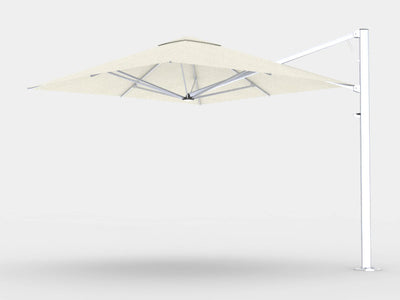
Yes, one or the other, and never neither. A cantilever umbrella carries its canopy off to one side of the mast, so the whole structure is a lever trying to rotate about its foot. Something has to resist that rotation for you: either mass sitting on the ground, or bolts fixed into it.
Shelta puts the principle plainly, noting that the cantilever design by its nature requires ballast, meaning weight at the base to provide stability. There is no third option where a cantilever umbrella simply stands there.
How much weight is needed to hold down a cantilever umbrella?
Well over 100 kg. The exact figure comes from the maker rather than a rule of thumb. Shadowspec's free-standing base takes 12 concrete pavers at 400mm x 400mm x 40mm, and warns that using the wrong number voids all warranty conditions. At the 13.7 kg published for the Midland Brick Cambridge Classic 40 in that size, 12 pavers come to 164 kg.
Shelta's own ballasted bases weigh 115 kg to 140 kg once filled with blue metal and sand, which lands in the same range by a different method. Anything advertised as a cantilever base at 30 kg or 40 kg is not, in our view, part of this conversation at all.
We have written the longer version of this separately, in how much weight a cantilever umbrella base actually needs, including how the figures change with canopy size.
What each surface needs before it can be bolted
The surface decides the mount, rather than the other way around. This is where most of the disappointment in this category originates, because a plate that suits one surface is useless on another, and we see that mistake made regularly.
| Surface |
Can it be bolted? |
What it needs |
| Reinforced concrete slab |
Yes |
110mm to 120mm thickness, 100 x 8mm minimum expansion or chemical anchors, stainless near salt or chlorine |
| Timber deck |
Yes, with work |
Bolts running through joists, extra joists and bracing added, hot-dipped galvanised or stainless fixings |
| Pavers on sand |
No |
Fixings must reach a slab beneath, or use an in-ground anchor in its own footing |
| Artificial grass |
No |
In-ground anchor cut through to a footing, or a ballasted base on top |
| Solid masonry wall |
Yes |
Load-bearing wall only, never cladding or plasterboard |
Two of those rows carry maker warnings worth repeating. Shelta states that installing into 110mm to 120mm reinforced concrete is vital, because in a wind an umbrella would likely pull out of sandstone or granite paving. For timber, Shadowspec's deck-mounting instructions require the bolts to run through a joist and recommend lifting planks to add extra joists and bracing first.
Ring us on 1300 515 620 before you order a mount for your umbrella. Describe the surface to us and we will tell you which of the four fits, including the occasions when our answer is that it should not be bolted down at all.
How do you stabilise a cantilever umbrella?
In order: get the mount right, then keep it maintained. Fixing choice does the heavy lifting, though three smaller things separate an umbrella that feels solid from one that rattles.
Ballast first, in full, to the maker's specification rather than to whatever pavers were in the shed. Then the rotation lock, which on a Shadowspec Serenity or Unity is a lever that has to seat properly; the maker's guidance on an umbrella that keeps rotating is simply to check that the base lock is seated and the lever closes fully. Then the fixings themselves, which loosen over a season.
Corrosion is the quiet one. Victoria's Building and Plumbing Commission guidance on balconies and decks names corrosion of bolts and fixing plates as a specific risk in coastal areas, and recommends an annual visual check. An umbrella bolted to a deck in 2026 deserves the same inspection as the deck itself.
What are the common problems with cantilever umbrellas?
Three, and two of them are installation rather than product. Under-ballasting is much the most common; it stays invisible until the day it matters. Base creep is the second, where wind vibration gradually walks an unfixed base across a smooth surface over a season. Anchor pull-out is the third; it is the only one of the three that appears on a surface which should never have been drilled in the first place.
The fourth complaint is not a fault at all: cantilever bases take up floor space. A ballasted base occupies roughly a square metre at ankle height, permanently, which is exactly the space a cantilever umbrella was bought to keep clear.
The verdict
Bolt it down where the surface allows, because that is the configuration the wind rating describes. Use a ballasted base where drilling is not possible, load it to the maker's full specification, and treat 30 km/h as the point where the canopy comes down. Where a solid wall is close enough to the seating, a wall bracket beats both.
Compare mounts and canopy sizes across our cantilever umbrellas collection, or ring Hayden on 1300 515 620. We will beat any genuine like-for-like price you find elsewhere; delivery is priced by state, with any warranty claim handled here rather than offshore.
You may also like
About the author:
“I have a real passion for helping transform outdoor spaces so people can relax, connect and entertain with confidence and pride. With My Acre, I love guiding homeowners to create beautiful and functional outdoor living areas."