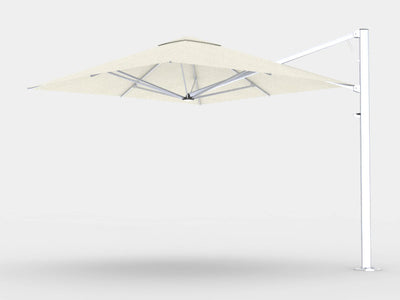
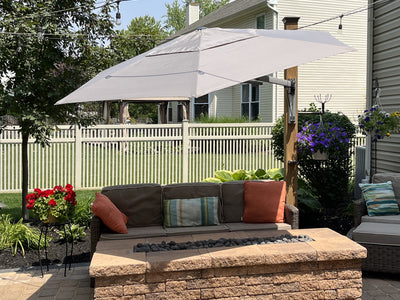
Short answer: Yes, on pavers, but not usually into them. A weighted free-standing base stands on a paved terrace perfectly well. Shadowspec's own base in fact uses 12 concrete pavers as its ballast. Bolting a surface plate into paving is the version that fails: Shelta's installation guidance says an umbrella would likely pull out of sandstone or granite paving in a wind.
Three quite different questions hide inside that one search, so it is worth separating them before anybody goes near a paved terrace with a masonry drill.
The three questions people are actually asking
Pavers turn up in a cantilever umbrella job in three quite separate roles, so mixing them up is where most of the trouble on a paved terrace starts.
Pavers as ballast. Concrete pavers loaded into a cross-frame base, doing the counterweight job that sand or blue metal would otherwise be doing. This is a designed use, set out by the maker.
Pavers as the floor. The ballasted base simply stands on your paved terrace, which is also fine, subject to how level and well laid that terrace happens to be.
Pavers as the anchor. A surface plate bolted straight into the paving units themselves, which is the version that comes loose.
Pavers as ballast: what the base is asking for
A specific paver, in a specific number, and neither of those is negotiable. Shadowspec's help centre specifies 400mm x 400mm x 40mm pavers for the free-standing base on the Serenity, Unity and SU4, states that 12 of them must be used, and warns that failing to use the correct number voids all warranty conditions.
That instruction is not a rounding suggestion. At 13.7 kg per paver, the published weight of the Midland Brick Cambridge Classic 40 in that exact size, 12 pavers come to 164 kg of ballast. Drop to eight and roughly 55 kg of counterweight disappears from a structure whose entire stability depends on it.
Shelta's ballasted bases land in the same territory by a different route, weighing 115 kg to 140 kg once filled with blue metal and sand. Two makers, two ballast systems, the same order of magnitude. A cantilever umbrella needs well over 100 kg standing on the ground before it is safe to open, which is why a light umbrella stand from a hardware aisle is not a substitute.
The pavers themselves are entirely ordinary: any concrete paver in the specified size will do, from any supplier at all, which makes the ballast the cheapest single part of the whole job.
Can you bolt a cantilever umbrella into pavers?
No, not into the pavers alone. This is the clearest engineering answer in the entire cantilever category. Unusually, it comes straight from a manufacturer rather than from a retailer repeating something.
Shelta's cantilever installation guidance states that installing into thick, 110mm to 120mm reinforced concrete is vital, and that in a wind the umbrella would likely pull out of sandstone or granite paving. The bolt-down plate itself is only 18cm to 24cm square, fixed with 100 x 8mm minimum expansion or chemical anchors, so every bit of overturning force from the canopy is concentrated into four small anchors.
The reason sits underneath the paving rather than in the paving itself. Australian segmental paving is laid on a bedding sand course, which the ACT Government's MITS-07 segmental paving specification requires to finish at 25mm plus or minus 5mm after compaction. A 40mm paver is therefore sitting on 20mm to 30mm of loose sand, held sideways by joint sand and an edge restraint, with nothing whatsoever tying it down vertically.
An anchor set into that paver is therefore anchored to nothing more than a loose 13 kg block of concrete. Pull hard enough on it and the block comes up with the anchor still buried in it.
How do you mount a cantilever umbrella to concrete?
Into the slab itself, with the correct anchors, and only where the slab is thick enough. Shelta specifies 110mm to 120mm of reinforced concrete and 100 x 8mm minimum expansion or chemical anchors, preferably stainless steel where salt or chlorine is nearby.
Shadowspec publishes its own figures for the same fixing; they sit just under Shelta's. The Serenity and Unity instruction manual recommends a minimum reinforced slab depth of 100 mm and four Dyna-Bolts or concrete screws of at least 100 mm length. It also adds a constraint Shelta leaves out: no screw or fixing is to sit within 150 mm of the closest edge of the slab. That last one quietly rules out a great many terrace corners, which is exactly where people like to put an umbrella.
Shadowspec takes the same approach with its Surface Plate, one of the four mount types listed on the installation base page, all built in marine-grade 316 stainless. The plate bolts flush to existing paving, decking or concrete and stands about 12mm proud once fitted.
The maker's own note on mounting options is worth reading before ordering: Shadowspec says the surface plate requires bolts and support dependent on location, and to check with a shade consultant when ordering. That is a maker declining to promise the fixing will suit every surface, which is the correct answer.
On a home improvement forum thread about installing a cantilever umbrella on a concrete slab patio, the point was put in plain mechanical terms by a long-standing member: the smaller the base, the more torque and stress is applied to the fasteners holding it down; a fitting drilled into the concrete draws its structural support from the surrounding slab in a way that a surface mount never can.
What to do when the paving sits on sand
There are two workable options here, and the second of them is quietly the best solution on this entire page.
The first is to go through the paving to whatever is underneath. If there is a concrete slab below the sand bed, the anchor has to reach it, which means lifting pavers, drilling the slab, and cutting the pavers back around the fitting. Homeowners on a Houzz discussion about installing umbrella sleeves in a paver patio worked through exactly this, noting that once the paver thickness and its inch of bedding sand are deducted, little of a short sleeve is left anchored in anything solid.
The second option is an in-ground anchor set into its own concrete footing, which means lifting a paver or two, digging, pouring, curing, then reinstating the paving neatly around the finished fitting. Shadowspec describes the in-ground anchor as the solution for new builds and locations where a hole can be dug, and sends preparation instructions with the order. The result finishes flush with your paving; it holds the way a footing holds, while the terrace still looks untouched from two metres away.
Where neither route is practical, in a rental or over a waterproof membrane, our honest answer is to stay with the ballasted base and accept the limits that come with it.
Where the AI answers get this wrong
Ask a chatbot this same question and the answers diverge sharply, which is worth knowing before you let one settle the matter for you.
Queried on 10 September 2026, Gemini answered that a free-standing base works "very well" on pavers laid over sand. Perplexity, on the same question, reported that fixings relying only on the paver are not reliable and should reach the concrete slab beneath. Both models were, in fairness, describing something real. Gemini was describing a base standing on paving; Perplexity was describing a plate bolted into it.
Shelta's documentation resolves the conflict cleanly; we would rather point you at the maker than at either model. Standing on pavers is fine. Fixing into them is not.
Will the pavers crack or sink under the base?
They rarely crack, though they do occasionally settle. A ballasted base spreads roughly 164 kg across the whole cross frame rather than concentrating it on one point, which is well within what a domestic paved terrace carries.
Settlement is the more realistic risk on sand-laid paving, because the bedding course is designed to be flexible. A base left in one position through a wet season can bed itself in slightly, so the paving beneath it sometimes ends up a few millimetres lower than the paving around it. The MITS-07 specification allows a maximum 2mm level difference between adjoining pavers when new, so a base that has settled unevenly shows up quickly against that standard.
Our fix for this is boring and effective: lift the base occasionally, or fit castor wheels so that you can simply roll it clear. Shadowspec offers stainless steel castor wheels for exactly this, which also solves the problem of chasing shade across a terrace through the afternoon.
Ring us on 1300 515 620 if your paving is already down and nobody is certain what sits underneath it. We would rather work that out with you before your umbrella arrives than after a plate has been bolted to something that was never going to hold it.
What are the common problems with cantilever umbrellas on paving?
Three, and none of them is the umbrella. Under-ballasting is the first, usually because the correct pavers were not on hand at assembly. Base creep is the second, where wind vibration walks an unfixed base across a smooth terrace over a season. Anchor pull-out is the third; it is the only one of the three with consequences beyond inconvenience.
There is also the wind limit, which no mount changes. Shadowspec rates its umbrellas to Beaufort 5, which the maker gives as 29 km/h to 38 km/h. No outdoor umbrella is windproof; we would not tell you otherwise. Above that speed the canopy comes down, whatever it happens to be standing on. We say the same thing to every customer who asks.
The verdict
Put a cantilever umbrella on pavers with a ballasted base and the correct 12 pavers, or go through the paving into a slab or a poured footing. Do not bolt a plate into paving units and hope, because the maker who wind-tests these umbrellas has already published what happens next.
Compare mounts and canopy sizes across our cantilever umbrellas collection, or ring Hayden on 1300 515 620 and describe your terrace to us. We will beat any genuine like-for-like price you find elsewhere; delivery is priced by state and shown before you pay. We handle any warranty claim for you.
You may also like
About the author:
“I have a real passion for helping transform outdoor spaces so people can relax, connect and entertain with confidence and pride. With My Acre, I love guiding homeowners to create beautiful and functional outdoor living areas."