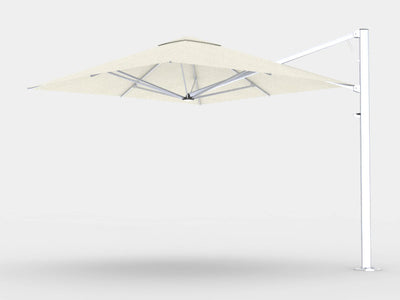
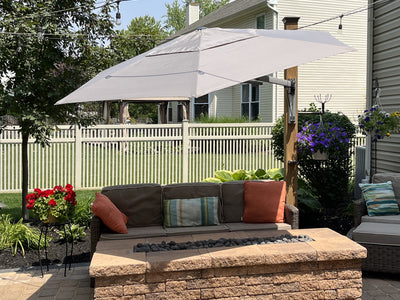
Short answer: Yes, a cantilever umbrella can go on a timber deck by one of two routes. A surface plate bolts down through the decking boards into the joists, which Shadowspec's own deck-mounting guidance requires. Or a ballasted free-standing base sits on top, carrying 115 kg to 165 kg of weight instead. Neither route is a job for four decking screws.
That is the whole answer, so if you only needed the yes, you can stop reading here. The rest is for anyone who now wants to know which of the two suits their deck, and what a builder will say when asked.
Can you attach a cantilever umbrella to a deck?
Yes, with a surface plate, provided the fixings reach structure. Shadowspec's deck-mounting instructions are explicit that the bolts must run through a joist; the maker then goes further, recommending that some planks be lifted and extra joists and bracing installed between the existing structure of the deck before the plate goes down. Washers under the plate let water escape rather than sit against the timber.
Shadowspec's printed manual goes further than its help centre. The Serenity and Unity instruction manual (P0126) sets out the deck fixing as four 12 mm countersunk bolts passing right through the decking, each secured underneath with a washer and locknut. Those bolts are not meant to land on the existing joists at all. The manual calls for an additional 100 mm by 100 mm timber joist to be inserted between the deck bearers to give the bolts a substantial anchor point, with two of them spaced 270 mm apart centre to centre, matching the bolt circle of the plate itself. It assumes existing framing of 200 mm by 50 mm joists under 20 mm decking. Hand those four numbers to a carpenter and the quote stops being guesswork.
Shelta, which manufactures cantilever umbrellas in Australia, arrives at the same place from the other direction. Its cantilever installation notes say the bolt-down plate can be used on a timber deck, then add that a builder should do the installation or an engineer should check the deck for stability beforehand.
Two makers, independently, treat a deck as a structure that needs checking rather than a surface that needs drilling, which is the signal worth reading before anyone reaches for a drill.
Why a normal deck is not designed for this
An Australian domestic deck is sized from span tables; those tables assume ordinary use. The WoodSolutions domestic timber deck design guide, published by Forest and Wood Products Australia, states that decks designed to AS 2870 and AS 1684 are for housing with average loads and ground conditions, and that where a deck has to carry a spa or a tiled finish the AS 1684 sizes are not applicable and a structural engineer should be consulted.
A cantilever umbrella is the same category of problem in a smaller package. The canopy is a sail: a Shadowspec Serenity in the 4.0m octagon size presents 12.6 m² of fabric, according to the specification on the Serenity product page. Every bit of wind load developed across that canopy arrives at one bolted plate, appearing as uplift on one side of it and compression on the other.
Victoria's Building and Plumbing Commission guidance on balconies and decks makes the general version of the point: heavy items add loads a balcony may not have been designed to support. It also flags the failure owners rarely inspect, which is corrosion of bolts and fixing plates in coastal air.
What the fixings actually have to do
Hold down, rather than hold up. The weight of the umbrella is inconsequential next to the overturning force a gust delivers into the mast, so the bolts spend their working life in withdrawal, resisting the attempt to pull them vertically out of the timber.
That is why decking boards alone are not a fixing point. Boards are fastened to the joists with as little as two nails each, per the same WoodSolutions guide, so a plate screwed into boards is relying on those nails to resist your umbrella. On a DIY Chatroom thread about adding blocking to secure a cantilever umbrella, the builders replying converged on solid blocking between the joists under the plate, hex bolts with washers and nuts through that blocking rather than lag screws, plus the largest bolt diameter the plate holes will take. One reply raised the detail nobody markets: the play that develops in a lag screw and timber connection once the umbrella is open in a breeze.
Fastener choice matters more outdoors than most people expect. WoodSolutions specifies that all framing bolts, screws and nails should be hot-dipped galvanised or stainless steel, because electroplated fasteners break down early. Shadowspec builds its four mount types, listed on the My Acre installation base page, in marine-grade 316 stainless for the same reason.
If that reads like a lot of carpentry for an umbrella, ring us on 1300 515 620 first and we will talk it through before anything gets ordered.
On the Bunnings Workshop community, a Bunnings team member answering a question about fixing a cantilever umbrella to a deck post put the risk plainly: fixing an umbrella to an existing structure introduces lateral forces, particularly from wind, that were not factored into the construction of that structure, so a builder or engineer should look at it first.
What kind of outdoor umbrella can be attached to a deck railing?
None of the cantilever range, which is the honest answer rather than the convenient one. A railing is designed to resist people leaning on it, not to anchor a 12 m² sail. Clamp-on railing brackets do exist for small market umbrellas of around 2 m; those are a different product class from a cantilever umbrella entirely.
Where your deck adjoins a solid wall, the better answer is to stop using the deck as the anchor. The Shadowspec Retreat is a wall-mounted umbrella that carries a 2.7m hexagonal canopy off a 526mm bracket, folds to 300mm deep against the wall, and puts no point load at all on the decking. Its own specification is clear that the wall has to be genuine structure: solid masonry, rendered brick or a properly framed timber wall, never cladding or plasterboard.
When a free-standing base is the better call
Renting, waterproof membranes, and any deck you would rather not drill. A ballasted base answers all three, because nothing is fixed to anything.
The trade-off is mass and floor space. Shelta's ballasted cantilever bases weigh 115 kg to 140 kg once filled with blue metal and sand. Shadowspec's free-standing base instead takes 12 concrete pavers at 400mm x 400mm x 40mm. Its help centre warns that using the wrong number voids all warranty conditions. At 13.7 kg per paver, the published weight of the Midland Brick Cambridge Classic 40, that is 164 kg standing in roughly one square metre of your deck. The base itself measures 936 mm by 417.5 mm on plan and weighs 20 kg empty. It does not sit flat on the boards, though: it runs on adjustable levelling feet, so that 164 kg reaches the deck through the feet rather than through the whole footprint. The contact area is far smaller than the plan dimensions suggest, which is the thing worth mentioning to whoever checks the deck.
Shelta is blunt about what ballast buys. Nothing will be as good as the bolt-down method, the maker says, because all of its wind testing is done bolted down. A free-standing base remains a legitimate choice. We sell plenty of them; our position is simply that a base is not the equal of a fixed installation.
A homeowner on Bunnings Workshop asking about shade around a pool described the same compromise from the other side: an existing umbrella that could not be used unless the day was still, a reluctance to leave a large sand base sitting on the deck, and a reluctance to bolt anything down in case the umbrella had to move later. That is the real decision most people are making.
What is too windy for a cantilever umbrella?
Roughly 30 km/h, whichever mount is used. Shadowspec rates its umbrellas to Beaufort 5, which the maker gives as 29 km/h to 38 km/h, and describes that speed as enough to blow over a full wine glass. Above it, the canopy comes down and the protection cover goes on.
No outdoor umbrella is windproof; we would not tell you otherwise. What a bolted deck mount buys is not immunity from wind. It removes the tipping failure, so the canopy becomes the thing at risk rather than the whole umbrella and whatever it lands on.
The parts nobody mentions before the install
Three, in the order they tend to bite. Lifting decking boards to add blocking is carpentry rather than assembly, so budget for a tradesman on an existing deck. A surface plate also leaves a permanent fixing point in the boards, standing about 12mm proud of them. And a ballasted base occupies floor space at ankle height for as long as the umbrella lives there.
Set against all three, a fixed mount frees the entire area beneath the canopy, which on a small deck is usually the whole reason for choosing a cantilever configuration in the first place.
Ring us on 1300 515 620 before you order a mount. Tell us the deck height, the joist spacing and whether the boards can come up. We will tell you which of the four Shadowspec mounts fits your situation, including the times our answer is a wall bracket instead of a deck fixing at all.
The verdict
A cantilever umbrella belongs on a deck when the deck has been checked, the plate lands on joists or added blocking, and your fixings are stainless or hot-dipped galvanised. Use a ballasted base where drilling is not an option, on the understanding that a base is a compromise rather than an equal. Where a solid wall sits within reach of the seating, the wall usually wins.
Compare the range on the cantilever umbrellas collection, or ring Hayden on 1300 515 620. We will beat any genuine like-for-like price you find elsewhere. Delivery is priced by state and shown before you pay; your warranty stays with us rather than an overseas call centre.
You may also like
About the author:
“I have a real passion for helping transform outdoor spaces so people can relax, connect and entertain with confidence and pride. With My Acre, I love guiding homeowners to create beautiful and functional outdoor living areas."