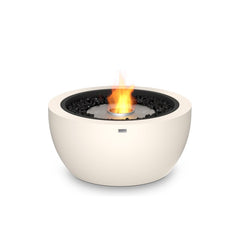
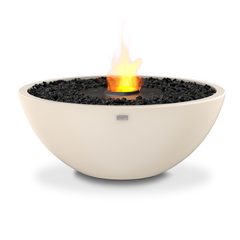
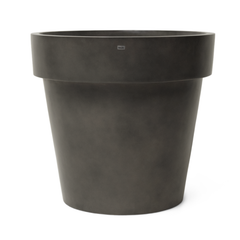
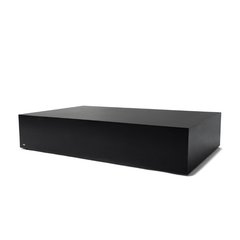
Short answer: For a bioethanol fire pit, concrete fire pits and stainless models both hold up outdoors when they are cared for, so the choice comes down to shape, weight, look and warranty. EcoSmart's Fluid Concrete Mix and Pod bowls weigh 21 to 49 kg and sit low, while the stainless Stix weighs 23 kg and stands 780 mm tall. Both styles burn bioethanol fuel in a stainless burner; all five sit in our bioethanol fire pit range.
That answer covers most buyers, although a fire table is a different question: our guide to the best material for a fire table is the better read there. The rest of this page covers cracking, rust, heat and safety in fire pits specifically.
What is the difference between a concrete and a steel fire pit?
The difference is mass and form. Four of the five EcoSmart fire pits we stock are cast in Fluid Concrete, while the fifth, the Stix, is built from stainless tubes. According to EcoSmart's own specifications, every one of them carries a Grade 304 stainless burner.
| Model |
Surround |
Size and weight |
| Mix 600 |
Fluid Concrete |
600 mm wide, 20.94 kg |
| Mix 850 |
Fluid Concrete |
850 mm wide, 42.64 kg |
| Pod 30 |
Fluid Concrete |
762 mm wide, 38.04 kg |
| Pod 40 |
Fluid Concrete |
1,000 mm wide, 49.04 kg |
| Stix |
Stainless steel |
780 mm tall, 23.14 kg |
The figures come from EcoSmart's pages for the Mix 600, Mix 850, Pod 30, Pod 40 and Stix. In practical terms, a concrete bowl is a fixture you position once, whereas the Stix is lighter than every concrete model except the Mix 600 while standing taller than any of them.
Will a concrete fire pit crack?
It can, although usually only on the surface. EcoSmart's warranty policy states that non-structural hairline cracks are possible in Fluid Concrete products and are not considered a manufacturing defect; natural variation in colour, texture and porosity is treated the same way.
That concession sits beside a concrete engineered to limit the problem. EcoSmart describe Fluid Concrete as dimensionally stable, with low expansion and contraction rates. The fully cured concrete does not retain water, EcoSmart add, which is why it resists freezing and thawing; that matters for durability because trapped water is what splits masonry.
Owners of masonry fireplaces tell a harsher story. A homeowner on Fine Homebuilding watched hairline cracks open on only the second fire, while a DoItYourself poster found mortar cracks reappearing every time the fire heated up. Both describe fires built directly inside masonry, which is not how an EcoSmart bowl works: its flame and most of its heat sit in the burner.
Does a steel fire pit rust?
Yes, if it is neglected; stainless is no exception. EcoSmart's clearance and care notes warn that stainless steel will rust or corrode over time if contamination or debris is not cleaned away promptly, which is why every model ships with a burner lid.
The Stix comes in brushed Grade 304 stainless or Grade 202 stainless with a black powder coating. Wood-burning metal fire pits are a different category of risk: CHOICE notes that standard steel pits are prone to rust and deteriorate much faster than stainless steel or cast iron.
Owners explain why: on TractorByNet one poster warns that water and ash together form an acid that eats through metal, so drainage matters. A DIY Chatroom thread describes a small gift pit rusting at the base within a couple of years, with replies saying thin metal fire pits are only meant to see a few seasons of heat.
Are concrete fire pits safe?
Yes, provided the burner is certified and the fire pit is placed correctly; safety comes from the burner and the setting, not the bowl. EcoSmart describe their fire pits as O-TL listed to UL 1370, EN 16647 BSI Certified and ACCC Safety Mandate compliant for bioethanol burners.
Placement rules apply to both concrete and metal fire pits. EcoSmart rule out grass, artificial turf, carpet, rock or any uneven surface, requiring the adjustable feet to stay on with at least 12.5 mm of air beneath. The same page asks for 600 mm between the flame and nearby furniture, plus 2,000 mm to overhanging branches. No surround changes a total fire ban either: a bioethanol fire pit is not exempt.
What is the best material for a fire pit?
For most buyers, concrete will last as long as they need it to. A Fluid Concrete Mix or Pod suits a courtyard or outdoor alfresco area where the fire pit becomes a permanent centrepiece with a low, sculptural look. The stainless Stix suits a narrow outdoor space that needs height rather than width, so choose by the footprint you have.
The honest caveat is the warranty: EcoSmart cover stainless steel parts for two years but cement for only one, so the steel option carries the longer cover. For a wood fire, neither suits, because EcoSmart prohibit wood in their burners; the Aluvy SAM brazier uses cast aluminium instead, which Aluvy describe as stainless.
A budget metal fire bowl from a hardware store will also burn wood for far less money, which makes it the better choice for an occasional campfire. On the owner evidence above, expect it to rust out rather than crack.
Choosing between them with us
The EcoSmart Mix 600 is the lowest-priced model in the range, while the EcoSmart Stix is the only stainless model. Every EcoSmart fire pit ships with free delivery; our price-beat promise applies if you find the same model for less elsewhere, while owner's after-care includes a check-in within a week of delivery.
We also handle any warranty claim on your behalf. If you are unsure which material suits your space, ring me on 1300 515 620; I will tell you what I would choose, even when that means the lower-priced option.
You May Also Like:
About the author:
“I have a real passion for helping transform outdoor spaces so people can relax, connect and entertain with confidence and pride. With My Acre, I love guiding homeowners to create beautiful and functional outdoor living areas."