Lisa B
★★★★★
10 Nov 2026Great customer service - they rang me to tell me exactly when my bbq was coming, they also sent over the instructions and price honoured me. 10/10.
Price beat promise

Most chosen
Not sure which one?
Hayden, co-owner
Tell me about your space and I will point you to the right fire. I reply the same business day.
Call 03 7073 2116Most chosen
Not sure which one?
Hayden, co-owner
Tell me what you love to cook and I will point you to the right setup. I reply the same business day.
Call 03 7073 2116Most chosen
Not sure which one?
Hayden, co-owner
Tell me the area you want to shade and I will point you to the right size. I reply the same business day.
Call 03 7073 2116Ponds and fountains
FountainsPondless waterfallsPond kitsDam aerators and fountainsPond filters and equipmentPool care
Robotic pool cleanersBrands
AquascapeAtlas FiltriBBA BiosolutionBeatbotBiancoClayTechDAB PumpsElevateKellockOaseOtterbinePietro StonewareRobo-TekWater MasterNot sure which one?
Hayden, co-owner
Tell me what you need the water to do and I will point you to the right pump, filter or water feature. I reply the same business day.
Call 03 7073 2116Where to start
Not sure which one?
Hayden, co-owner
Tell me what you are planning and I will point you to the right fit. I reply the same business day.
Call 03 7073 2116Spas
Spas and hot tubsComingSwim spasComingNot sure which one?
Hayden, co-owner
Tell me how you want to relax and I will point you to the right spa or sauna. I reply the same business day.
Call 03 7073 2116Not sure which one?
Hayden, co-owner
Tell me what you are planning and I will point you to the maker that suits it. I reply the same business day.
Call 03 7073 2116
Fire
Most chosen
Outdoor Kitchens
Most chosen
Shade
Most chosen
Water
Ponds and fountains
FountainsPondless waterfallsPond kitsDam aerators and fountainsPond filters and equipmentPool care
Robotic pool cleanersGarden
Where to start
Spas & Saunas
Spas
Spas and hot tubsComingSwim spasComingBrands
About
Who we are
Who is My Acre?Why My Acre?Meet Hayden and TimOur installersContact usWhat we promise
Price beat promiseShipping and deliveryWarranty and claimsReturns and exchangeGuides and resources
Customer resourcesCustomer reviewsBlogs


Short answer: Sintered stone, porcelain and stainless steel are the outdoor kitchen benchtop materials that cope best with Australian sun, heat and rain, although stainless steel needs grade 316 within five kilometres of the surf. Granite works if it is sealed every year. Engineered stone is no longer an option: installing it has been banned in Australia since 1 July 2024.
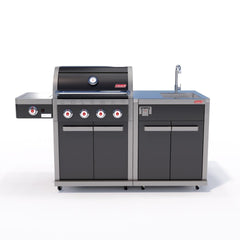
For most buyers, that short answer is enough to narrow your shortlist to two or three materials. The detail below explains how each material behaves outdoors, using figures from the material makers and standards bodies rather than from retailers. The modular cabinets in our range of outdoor kitchens arrive with their tops already chosen, so the same tests apply to the top on your module.
The best outdoor benchtop material absorbs almost no water, holds its colour under UV and can withstand heat from the barbecue. Measured against those three tests, the common surfaces compare as follows, from lowest maintenance to highest.
| Material | Where it performs | What to watch |
|---|---|---|
| Sintered stone | 0.1% water absorption and a frost test pass on the Dekton data sheet | Check the data sheet for the exact slab |
| Porcelain | Resin-free porcelain is not classed as engineered stone | Outdoor performance varies by maker |
| Stainless steel | Heat, cleaning and weather | Grade 304 tea stains near the surf |
| Granite | Heat and hard wear | Stain resistant, not stain proof; seal yearly |
| Aluminium | Rustproof and made to stay outside all year | Painted tops mark if used as a chopping board |
| Concrete | Custom shapes and sizes | Only as durable as its sealer |
| Timber | A warm look that can be sanded back | Sheltered spots only, frequent oiling, well clear of the barbecue |
No. Safe Work Australia explains that since 1 July 2024 it has been an offence in every state and territory for a business to make, supply, process or install engineered stone benchtops, panels or slabs. The ban came in after a rise in silicosis among stone workers. Resin-free porcelain and sintered stone fall outside it.
Owners were warning against engineered stone outdoors long before the ban. On the homeone forum, members warned in 2009 that engineered stone would warp in the sun and in 2013 that UV would make it fade and chalk. Another member noted in 2011 that one brand's warranty excluded outdoor kitchens. A Bunnings Workshop moderator made the same point in 2024: none of the store's stone tops were rated for outdoor use, even under a covered patio.
An existing bench made before the ban can stay where it is. The rules allow limited work on installed stone, such as repairs and minor modifications, but a business doing that work must notify the WHS regulator first (Victoria excepted) and control the dust. That matters if your gasfitter needs to cut a hole through an older top.
Sintered stone performs well outdoors because it holds almost no water, which is the basis of its durability; porcelain can match it, but only a data sheet shows whether a given slab does. Cosentino's Dekton technical data sheet lists water absorption of 0.1% under EN ISO 10545-3. The same sheet records a pass with no damage in the EN ISO 10545-12 frost test and stain resistance class 5 under EN ISO 10545-14. Cosentino also markets Dekton for outdoor benchtops on its UV and heat resistance.
Frost matters in cold inland and elevated areas; one Whirlpool member planning an alfresco kitchen in the Adelaide Hills noted that it gets quite frosty there. The caveat is that porcelain is a broad category, so the data sheet for your exact slab is the real test, not the word porcelain on a quote.
Grade 316 near the coast, grade 304 elsewhere. The Australian Stainless Steel Development Association says grade 316 should be the minimum within five kilometres of the surf; lower grades such as 304, it adds, will probably tea stain in a marine environment.
Coleman's modules use 304-grade stainless steel tops, according to the storage module specification. That grade suits most suburbs; within sight of the surf it means a regular wash with fresh water, because ASSDA describes rain-sheltered spots, such as under eaves, as very aggressive conditions for staining.

Picture a courtyard kitchen two streets back from the beach, its stainless prep module tucked under the eaves where rain never reaches, while the barbecue stands in open air beyond them. After a winter of salt air, the grade 304 top shows the brown tea staining that ASSDA describes. Choosing grade 316 for that site, or rinsing the bench with fresh water as part of the weekly routine, is exactly what ASSDA's guidance points to.
Stainless steel also gets hot: Coleman's barbecue manuals warn that the stainless and painted steel parts can become very hot in direct sun, so a stainless bench in full afternoon sun deserves a quick touch before anyone leans on it.
Granite is a durable natural stone, but it needs sealing once a year. The natural stone maintenance guide from Stoneware Productions describes granite as stain resistant but not stain proof. It recommends sealing once a year against oil and grease, advises against placing very hot or very cold items directly on the stone and notes that marble reacts with food acids.
Concrete is only as durable as the sealer protecting it, so sealing is part of its maintenance for life. A Bunnings Workshop member who poured a concrete benchtop for a covered outdoor kitchen in 2025 had to redo the top sealant three times, because a silicone form release stopped the sealer from bonding.
Timber suits sheltered positions and owners who actively enjoy regular maintenance, since its resistance to weather depends on the finish. A Bunnings Workshop moderator advised in 2024 that timber panels must be sealed and kept sheltered. The same answer warned that timber has to be isolated from barbecue heat. On homeone, a thick merbau slab curled and warped at the ends; another owner described oiling merbau shelves beside a pizza oven about once a month.
Anything close to your cooktop should be non-combustible. Coleman's Revolution 4 Burner manual asks for more than 91.4 cm between the barbecue and combustible materials. A 2019 Whirlpool thread on an outdoor kitchen benchtop shows how easily timber ends up too close: the owner asked whether a hardwood panel could line a built-in barbecue cut-out; the replies treated that timber as combustible. Stone, porcelain, stainless steel or fibre cement belong around the barbecue; timber belongs further along the run, more than 91.4 cm from the barbecue.
For a compact charcoal kitchen, yes. The Aluvy JEAN has a worktop made from a solid 8 mm aluminium plate, finished in anodised epoxy paint that Aluvy says is made for outdoor use all year round. Aluvy also warns never to cut directly on the surface, because the knife damages the paint, so a board on the bench is part of owning one.

The Aluvy JEAN Basalt Kitchen Cabinet attaches to the side of a MARCEL charcoal barbecue, which keeps the whole bench free of gas work.
Choose the benchtop for where it will sit, not how it looks in a showroom. Put stainless steel or a sintered slab beside the barbecue, use grade 316 or a regular wash near the coast and keep timber where rain never reaches. If you are weighing a modular kitchen against a custom bench, send us the site details and we will tell you which tops suit it.
Every outdoor kitchen from My Acre comes with our price-beat promise and owner's after-care: a fit check before anything ships, a shepherded delivery and a check-in within a week. We also handle the warranty for you. Ring Hayden on 03 7073 2116, or browse the outdoor kitchens collection.

 Outdoor Kitchens
 Outdoor Kitchens
 Outdoor Kitchens

Want a written quote?
Tell me what you are after. I send it the same business day.
Great customer service - they rang me to tell me exactly when my bbq was coming, they also sent over the instructions and price honoured me. 10/10.
Great table delivered quickly! Very happy
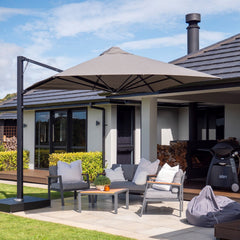
We recently had a Serenity Cantilever umbrella installed and the My Acre team were fabulous. From initially advising us what would suit our tricky terrace best, to keeping us informed on delivery and installation and ...
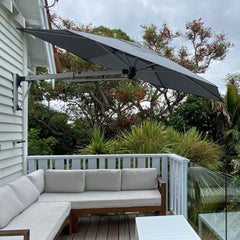
Really happy with my Shadowspec Retreat wall-mounted umbrella. Hayden at My Acre has been great — always quick to respond and very helpful. I recently needed to make a small warranty claim, and Hayden organised everyt...
Thanks to the My Acre team delighted with the end product of the Umbrella cantilever shade. In all respects Hayden was fantastic details, invoicing, adjusting delivery to suit us and supporting the installation with a...
Australian owned · every order personally followed up