
Lisa B
★★★★★
10 Nov 2026Great customer service - they rang me to tell me exactly when my bbq was coming, they also sent over the instructions and price honoured me. 10/10.
Price beat promise

Most chosen
Not sure which one?
Hayden, co-owner
Tell me about your space and I will point you to the right fire. I reply the same business day.
Call 03 7073 2116Most chosen
Not sure which one?
Hayden, co-owner
Tell me what you love to cook and I will point you to the right setup. I reply the same business day.
Call 03 7073 2116Most chosen
Not sure which one?
Hayden, co-owner
Tell me the area you want to shade and I will point you to the right size. I reply the same business day.
Call 03 7073 2116Ponds and fountains
FountainsPondless waterfallsPond kitsDam aerators and fountainsPond filters and equipmentPool care
Robotic pool cleanersBrands
AquascapeAtlas FiltriBBA BiosolutionBeatbotBiancoClayTechDAB PumpsElevateKellockOaseOtterbinePietro StonewareRobo-TekWater MasterNot sure which one?
Hayden, co-owner
Tell me what you need the water to do and I will point you to the right pump, filter or water feature. I reply the same business day.
Call 03 7073 2116Where to start
Not sure which one?
Hayden, co-owner
Tell me what you are planning and I will point you to the right fit. I reply the same business day.
Call 03 7073 2116Spas
Spas and hot tubsComingSwim spasComingNot sure which one?
Hayden, co-owner
Tell me how you want to relax and I will point you to the right spa or sauna. I reply the same business day.
Call 03 7073 2116Not sure which one?
Hayden, co-owner
Tell me what you are planning and I will point you to the maker that suits it. I reply the same business day.
Call 03 7073 2116
Fire
Most chosen
Outdoor Kitchens
Most chosen
Shade
Most chosen
Water
Ponds and fountains
FountainsPondless waterfallsPond kitsDam aerators and fountainsPond filters and equipmentPool care
Robotic pool cleanersGarden
Where to start
Spas & Saunas
Spas
Spas and hot tubsComingSwim spasComingBrands
About
Who we are
Who is My Acre?Why My Acre?Meet Hayden and TimOur installersContact usWhat we promise
Price beat promiseShipping and deliveryWarranty and claimsReturns and exchangeGuides and resources
Customer resourcesCustomer reviewsBlogs


Short answer: A built-in BBQ is worth it for owners who cook outside most weeks, plan to stay in the home and will pay for a non-combustible enclosure plus a licensed gasfitter. For everyone else, a freestanding barbecue, or a modular kitchen built around one, gives most of the bench space with less commitment and can move house when you do.
If that answers your question, the Coleman range shows the modular middle path in finished form, with the cooking and bench space of a built-in. The comparison below covers what the extra cost of a built-in actually buys, what the installation requires and the situations that change the answer.
A built-in BBQ is a barbecue head without a cart, designed to drop into a cavity in a bench. A freestanding barbecue arrives on its own cart, with wheels, side shelves and a place for the gas bottle. The cooking performance itself can be identical: Coleman sells its Pro Series 5-Burner both ways; both versions list the same 5,174 cm² total cooking surface.
The differences sit around the cooking surface rather than on it. Coleman lists the built-in version for natural gas at 75 MJ/h. The cart version lists 86.9 MJ/h in total, including an 11.9 MJ/h wok burner that the built-in head does not carry; take the wok burner away and the cart's figure matches the built-in's 75 MJ/h. Coleman also describes the cart as compatible with its modular outdoor kitchen system.
Side by side, the pros and cons of each format compare like this for a typical Australian patio or backyard.
| What matters | Built-in BBQ | Freestanding BBQ |
|---|---|---|
| Installation | A non-combustible enclosure and a licensed gasfitter | Assembly, then a gas bottle or a gas point fitted by a gasfitter |
| Moving house | Stays with the house | Comes with the owner |
| Replacing the barbecue | The new head has to fit the old cavity | Any model can take its place |
| Look | One continuous bench | A cart, unless modules frame it |
| Where it can stand | Wherever the manual's clearances allow | The same clearances apply |
Built-in BBQs are expensive because the barbecue is the smaller part of the bill. The head needs a bench built to hold it, lined with non-combustible material, plus gas work that only a licensed tradesperson can do. Our guide to what an outdoor kitchen costs in Australia sets out the joinery and trade figures, so they are not repeated here.
Buyers notice the premium on the head as well. Under a video on converting a freestanding grill into a built-in, several commenters question why a drop-in version of a grill costs more than the same grill on a stand; one suggests fitting a non-built-in unit into the bench instead.
That shortcut is where the risk sits. A freestanding barbecue is designed to stand in open air. Coleman's Revolution 4 Burner manual asks for more than 91.4 cm between the barbecue and combustible material, which a timber-framed bench wrapped around a cart would not provide. If the saving matters, a modular kitchen gets the same result without the risk.
Consider one version of the decision. A couple finishing a new alfresco are offered a rendered masonry bench with a cavity for a barbecue. A head such as Coleman's Pro Series 5-Burner Built-In must not be lit under the alfresco roof, because its manual rules out a covered area. The bench therefore stands on open paving beyond the roof line, clear of the windows and the fence, with the gas point extended out to it. The cavity is sized for whichever head they choose that year.
When that head eventually wears out, the replacement has to match the hole, or the stone top gets cut and the bench rebuilt. A freestanding barbecue between two 69.5 cm modules keeps that flexibility for the long term: the barbecue rolls out, a new one rolls in and the bench stays exactly as it was.
A built-in head needs non-combustible material underneath it and on every side of it. A Bunnings Workshop moderator told one owner in 2025 that the frame for a built-in BBQ must be clad in fibre cement sheet, with ventilation in line with the AS/NZS 5601.1 gas installation standard. The barbecue itself, the moderator added, has to sit on non-combustible sheet. That owner was building under cover, which is a question for the barbecue's maker before it is one for the builder. Coleman's Pro Series 5-Burner Built-In manual says not to light the barbecue in a covered area or under the overhang of a house, so its enclosure belongs in open air.
Forum threads show where owners go wrong. In a 2020 Whirlpool thread on an alfresco kitchen fit-out, a respondent who builds barbecue enclosures described lining the cavity with fire-rated cement panel to protect the cabinets beside and below the barbecue. In 2025, a new home owner on Bunnings Workshop found an existing outdoor kitchen with timber sheeting behind the barbecue space, which the moderator said needed at least a cement sheet heat guard.
Cabinet materials matter as much as the lining. A Bunnings Workshop moderator warned in 2020 that even marine-grade ply can swell from excessive moisture. A 2024 Whirlpool reply made the same point about moisture-resistant MDF, even under cover.
Connecting a built-in barbecue to gas is licensed work in both states whose rules we checked. In New South Wales, the government states that a licence is needed for any gasfitting work, including LP gasfitting, regardless of the cost. Energy Safe Victoria tells households to always use a licensed gasfitter for any installation, repair or renovation that involves gas.
The same Victorian page notes that licensed gasfitters must carry insurance providing a six-year warranty on their work. My Acre does not install gas, so your gasfitter makes the connection; the job at our end is making sure the barbecue suits the gas supply you already have.
The manual's heat clearances apply to a built-in head as much as a freestanding one. Coleman's Pro Series 5-Burner Built-In manual repeats the positioning rules of its freestanding models: no covered area or overhang, more than 91.4 cm to combustible materials and nothing near windows, siding or fencing.
Cutting a gas hole through an existing benchtop needs care if the top is engineered stone. Safe Work Australia allows limited work on installed engineered stone, such as minor modifications, but a business must notify the WHS regulator first (except in Victoria) and control the dust. The Bunnings moderator gave the same caution in that 2025 thread.
A built-in BBQ usually runs on the gas already piped to the house, so check your supply before choosing a head. Coleman lists its Pro Series 5-Burner Built-In for natural gas, while its Revolution barbecues are listed for ULPG. A household without a natural gas connection therefore needs a model listed for LPG, not a workaround.
Western Australia's guide to safe locations for gas barbecues lists the connection options for an outdoor barbecue: a flexible hose to a natural gas bayonet point, a fixed connection to gas piping or an LPG cylinder. The same guide says cylinders should be stored outdoors and upright. Coleman's manual adds that a cylinder not connected for use must not be stored near the barbecue, which rules out keeping the spare bottle in the cupboard beside it.
Possibly, but we could find no Australian property data that shows it. The claim that a built-in barbecue lifts resale value appears in many online answers, but we could not trace it to Australian property or valuation data. Treat a built-in as a purchase for the years you will use it rather than as an investment. Framed that way, the decision about your own backyard becomes much clearer.
For most buyers, yes. A modular kitchen puts a freestanding barbecue beside cabinets that join onto it, so the run reads as one bench while the barbecue keeps its own frame. Coleman describes its Revolution 4-Burner barbecue as designed to connect to its outdoor kitchen modules. It also lists the Pro Series cart as an upgrade path to a fully integrated outdoor kitchen.
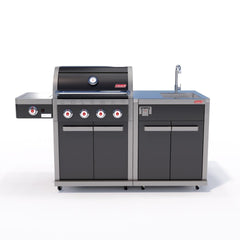
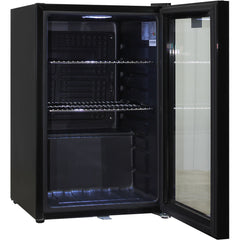
The Coleman Revolution 4 Burner Outdoor Kitchen we carry comes with sink, storage and fridge modules in three configurations.

The practical gains are the ones a fixed installation gives up; they matter most over the long term. The barbecue can be replaced without rebuilding the bench; the whole run can move house; no cavity has to be built or lined. Coleman lists a 5-year limited warranty on its modules. The fridge inside a fridge module carries 1 year, which is worth weighing against a separate unit from our outdoor bar fridge guide.
Owners who would rather skip gas work entirely have a charcoal option. The Aluvy MARCEL Original Charcoal Barbecue takes a JEAN cabinet on one or both sides, with no gas line to connect or certify.

A built-in BBQ is not worth it for renters, for owners likely to sell within a few years or for anyone who barbecues a handful of times a year. It is also the wrong choice where the only space for it is under the alfresco roof and the barbecue's manual rules that out. In each case a good freestanding barbecue, or a modular run, does the same job for less money and less building work.
A built-in is worth it where the outdoor kitchen is the centre of the house for half the year, there is open ground for it beyond the roof line, the gas point is already close and the owners are staying put. That combination justifies the enclosure, the trades and the permanence.
Start with the gas: where the point is, whether it supplies natural gas or relies on a bottle and who will connect it. Then choose the format. If you send us a photo of the space with the gas point, the roof line, the windows and the fences marked, we will tell you which suits, even when the answer is a freestanding barbecue that costs less.
Every outdoor kitchen from My Acre comes with our price-beat promise and owner's after-care: a fit check before anything ships, a shepherded delivery and a check-in within a week. We also handle the warranty for you. Ring Hayden on 03 7073 2116 to talk it through, or browse the outdoor kitchens collection.

 Outdoor Kitchens
 Outdoor Kitchens
 Outdoor Kitchens

Want a written quote?
Tell me what you are after. I send it the same business day.
Great customer service - they rang me to tell me exactly when my bbq was coming, they also sent over the instructions and price honoured me. 10/10.
Great table delivered quickly! Very happy
We recently had a Serenity Cantilever umbrella installed and the My Acre team were fabulous. From initially advising us what would suit our tricky terrace best, to keeping us informed on delivery and installation and ...
Really happy with my Shadowspec Retreat wall-mounted umbrella. Hayden at My Acre has been great — always quick to respond and very helpful. I recently needed to make a small warranty claim, and Hayden organised everyt...
Thanks to the My Acre team delighted with the end product of the Umbrella cantilever shade. In all respects Hayden was fantastic details, invoicing, adjusting delivery to suit us and supporting the installation with a...
Australian owned · every order personally followed up