Lisa B
★★★★★
10 Nov 2026Great customer service - they rang me to tell me exactly when my bbq was coming, they also sent over the instructions and price honoured me. 10/10.
Price beat promise

Most chosen
Not sure which one?
Hayden, co-owner
Tell me about your space and I will point you to the right fire. I reply the same business day.
Call 03 7073 2116Most chosen
Not sure which one?
Hayden, co-owner
Tell me what you love to cook and I will point you to the right setup. I reply the same business day.
Call 03 7073 2116Most chosen
Not sure which one?
Hayden, co-owner
Tell me the area you want to shade and I will point you to the right size. I reply the same business day.
Call 03 7073 2116Ponds and fountains
FountainsPondless waterfallsPond kitsDam aerators and fountainsPond filters and equipmentPool care
Robotic pool cleanersBrands
AquascapeAtlas FiltriBBA BiosolutionBeatbotBiancoClayTechDAB PumpsElevateKellockOaseOtterbinePietro StonewareRobo-TekWater MasterNot sure which one?
Hayden, co-owner
Tell me what you need the water to do and I will point you to the right pump, filter or water feature. I reply the same business day.
Call 03 7073 2116Where to start
Not sure which one?
Hayden, co-owner
Tell me what you are planning and I will point you to the right fit. I reply the same business day.
Call 03 7073 2116Spas
Spas and hot tubsComingSwim spasComingNot sure which one?
Hayden, co-owner
Tell me how you want to relax and I will point you to the right spa or sauna. I reply the same business day.
Call 03 7073 2116Not sure which one?
Hayden, co-owner
Tell me what you are planning and I will point you to the maker that suits it. I reply the same business day.
Call 03 7073 2116
Fire
Most chosen
Outdoor Kitchens
Most chosen
Shade
Most chosen
Water
Ponds and fountains
FountainsPondless waterfallsPond kitsDam aerators and fountainsPond filters and equipmentPool care
Robotic pool cleanersGarden
Where to start
Spas & Saunas
Spas
Spas and hot tubsComingSwim spasComingBrands
About
Who we are
Who is My Acre?Why My Acre?Meet Hayden and TimOur installersContact usWhat we promise
Price beat promiseShipping and deliveryWarranty and claimsReturns and exchangeGuides and resources
Customer resourcesCustomer reviewsBlogs


Short answer: Cover the people, not the barbecue. A roof over the prep bench and dining table makes a covered outdoor kitchen usable in wet weather and midsummer sun. A Coleman barbecue should not be used under it: Coleman's manuals say not to light the barbecue in a covered area or under an overhang. Any gas installation needs a licensed gasfitter.
That is the short version; the longer one below covers the gas rules, smoke and grease, the weather and what a roof adds to the budget, using the outdoor kitchens in the My Acre range as worked examples.
Covered is better for the people using the kitchen space; uncovered is simpler for the barbecue and the appliances around it. A roof gives shade in January and shelter in July; owners who built without one tend to say so afterwards. Commenters under one outdoor kitchen regrets video call cooking under open sky in a hot climate a mistake. A viewer of an outdoor kitchen ideas video warns against building without total roof coverage anywhere with wet winters. That advice suits your bench and table; for a Coleman barbecue, the roof has to stop short of the barbecue itself, as the next section explains.
The trade-offs sit on both sides, as the comparison below shows for a typical suburban backyard with a pergola or solid roof.
| Consideration | Covered | Uncovered |
|---|---|---|
| Comfort | Shade and rain shelter for the cook and guests | The weather decides when it gets used |
| Gas barbecue | Coleman's manuals rule it out; other makers and state rules may restrict it | The fewest restrictions |
| Smoke and grease | Can collect under the roof | Disperse in open air |
| Stainless steel near the coast | Rain-sheltered surfaces stain faster | Rain helps rinse the surface |
| Cost and approvals | A roof adds building cost and may need approval | No roof to pay for or approve |
Only if the barbecue's maker allows it. Some do not. Coleman's assembly manuals for its Revolution 4 Burner, Revolution Dual Fuel and Pro Series 5-Burner Built-In all say not to light the barbecue under a combustible object such as an awning, in a covered area such as a porch or gazebo, or under the overhang of a house, garage or other structure. The manuals give the reason: an overhang deflects flare-ups and radiates heat into the structure itself.
That is an uncomfortable answer from a shop that sells Coleman kitchens. We would rather give it here than after delivery, because the written instructions are what count if anything goes wrong.
State regulators set the floor beneath the maker. Western Australia's guide to safe locations for gas barbecues says it does not take precedence over the manufacturer's instructions. It requires clearances to meet those instructions and sets at least 1,200 mm between a domestic barbecue's cooking surface and any roof above, to avoid combustion on surfaces laden with grease. That figure applies only where the maker allows a roof at all; it does not override Coleman's instruction to keep its barbecues out from under one.
Whatever the roof, any gas installation needs a licensed gasfitter. Energy Safe Victoria tells households to always use a licensed gasfitter for any installation, repair or renovation that involves gas. Ask your gasfitter to check the barbecue's position against its manual before your roof goes on.
Where a maker does allow use under cover, your space still has to count as outdoors in the regulator's sense. Western Australia accepts four open sides under a roof, two walls under a roof, or three walls with one open side of at least 25 per cent of the perimeter and 30 per cent or more of the remaining walls unrestricted. Our outdoor kitchen ideas guide shows how a covered Coleman run works instead: the roof over the modules and the table, with the barbecue in open air beyond it.
The word that catches owners out is unrestricted. The same guide accepts a balcony or verandah only where the barbecue will not cause a hazard and the maker's instructions allow it. It then asks for 20 per cent of the wall area to remain permanently open and unrestricted. In a 2020 Whirlpool thread about an alfresco closed in with bifold doors and windows, the replies were blunt: that space was enclosed, because open sections have to be permanently open rather than doors or windows that happen to be open on the day.
A rangehood does not change that classification. In the WA guide, mechanical ventilation belongs to barbecues certified for indoor use and to commercial units; for a barbecue certified for outdoor use, the test is open sides. The guide also states that it does not recommend modifying outdoor barbecues for use indoors.
Keep your barbecue out from under it. In open air the smoke rises and disperses, with no roof lining for the grease to settle on; for a Coleman barbecue, the manual requires that position anyway. Owners who cook under a roof show what the alternative involves. A Bunnings Workshop moderator recommended a rangehood to one owner in 2021 specifically to stop grease building up on the underside of a corrugated roof. In 2023 a moderator suggested a wall-mounted exhaust fan for another owner whose covered patio held barbecue smoke, noting that a whirlybird would do little under an open roof assembly.
A member who put a polycarbonate roof over a brick barbecue area installed a ducted exhaust hood to push smoke outside. Those fixes, like WA's 1,200 mm between the cooking surface and the roof, belong to barbecues whose makers allow a roof. None of them makes a Coleman barbecue suitable for use under one; for these kitchens the answer is the open end of the run, beyond the roof line.
Partly. A roof gives the cabinets and appliances real protection from direct sun and downpours, but wind-driven showers still reach them. A Bunnings Workshop member who built a covered outdoor kitchen in 2025 noted that it still gets slightly wet when heavy rain comes in sideways, so the cabinet base was sealed against weather and insects. Whirlpool members describe the same limits: one owner planning an undercover outdoor kitchen still expected rain mist on the bench in 2019, while another reported in 2024 that water leaks in beneath a post of a covered kitchen.
Near the coast, a roof can make your stainless steel look worse rather than better. The Australian Stainless Steel Development Association describes rain-sheltered spots, such as the underside of roofs and eaves, as very aggressive conditions for tea staining. It recommends grade 316 as the minimum within five kilometres of the surf. Coleman's module tops are grade 304, so a covered coastal kitchen needs a regular fresh-water wash.
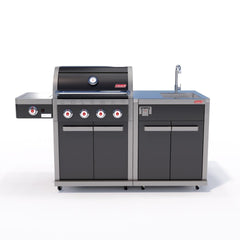
Uncovered kitchens work when the pieces are designed for it, which suits a backyard without a pergola or roof. Aluvy says the cast aluminium MARCEL barbecue can stay on the terrace all year round and supplies it with a protective cover. A matching protective cover for the JEAN cabinet does the same job for the bench beside it.

Picture a paved alfresco under a flat Colorbond roof on a January afternoon. The first plan puts the whole kitchen against the back wall, under the roof, because that is where the gas point happens to be. The barbecue then sits beneath a structure its manual rules out, while smoke drifts back under the roof towards the sliding door.
Moving the barbecue out past the roof edge, more than 91.4 cm from the nearest timber post and clear of the windows, puts it in open air while the fridge and sink stay in the shade. The guests at the dining table stay cool, the cook works in fresh air and the smoke rises instead of drifting inside.
The general rule follows from that: put the roof over the bench and the table, then let the barbecue stand at the open end. In practice that means a straight or L-shaped run whose prep, sink and fridge modules sit under cover while the barbecue sits beyond the roof line, more than 91.4 cm from any combustible material and away from windows, cladding and fences. The cook steps out from under the roof to turn the food; everyone else stays dry.
Two more services belong in your plan from the start. Lighting for evening cooking and a weatherproof power point for the fridge both need an electrician. The wiring is far easier to run before the roof is lined.

If your covered area is also where a fire will go, the guide to whether a fire table can go under a covered patio covers the clearances for bioethanol. A fire under the roof and a barbecue beyond it is a combination that works through winter as well as summer.
A covered outdoor kitchen costs the kitchen plus the roof. The hipages patio cover cost guide, last updated on 6 January 2026, puts a professionally installed patio cover at $45 to $100 per square metre. For a standard 20 m² patio, that guide gives $900 to $2,000 for a basic cover and $3,000 to $5,000 for premium materials.
The kitchen side starts at $2,373 for a Coleman Revolution 4 Burner Outdoor Kitchen with a sink module, at My Acre's price on 22 September 2026. Our outdoor kitchen cost guide covers the trades, custom joinery and the approval question a roof raises. Rules differ by state and council, so ask your council before the builder quotes.
Start with the barbecue's manual, then draw the roof line around it. If you send us a photo of the alfresco with the roof edge, windows and fences marked, we will check the plan against the maker's clearances before anything is ordered. If a different barbecue suits the space better, we will tell you plainly.
Every outdoor kitchen from My Acre comes with our price-beat promise and owner's after-care: a fit check before anything ships, a shepherded delivery and a check-in within a week. We also handle the warranty for you. Ring Hayden on 03 7073 2116, or browse the outdoor kitchens collection.

 Outdoor Kitchens
 Outdoor Kitchens
 Outdoor Kitchens

Want a written quote?
Tell me what you are after. I send it the same business day.
Great customer service - they rang me to tell me exactly when my bbq was coming, they also sent over the instructions and price honoured me. 10/10.
Great table delivered quickly! Very happy
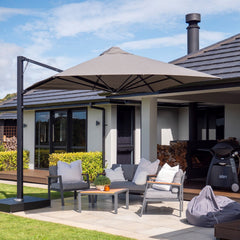
We recently had a Serenity Cantilever umbrella installed and the My Acre team were fabulous. From initially advising us what would suit our tricky terrace best, to keeping us informed on delivery and installation and ...
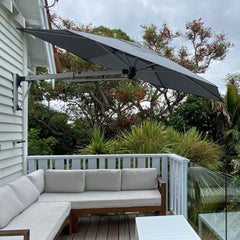
Really happy with my Shadowspec Retreat wall-mounted umbrella. Hayden at My Acre has been great — always quick to respond and very helpful. I recently needed to make a small warranty claim, and Hayden organised everyt...
Thanks to the My Acre team delighted with the end product of the Umbrella cantilever shade. In all respects Hayden was fantastic details, invoicing, adjusting delivery to suit us and supporting the installation with a...
Australian owned · every order personally followed up