Lisa B
★★★★★
10 Nov 2026Great customer service - they rang me to tell me exactly when my bbq was coming, they also sent over the instructions and price honoured me. 10/10.
Price beat promise

Most chosen
Not sure which one?
Hayden, co-owner
Tell me about your space and I will point you to the right fire. I reply the same business day.
Call 03 7073 2116Most chosen
Not sure which one?
Hayden, co-owner
Tell me what you love to cook and I will point you to the right setup. I reply the same business day.
Call 03 7073 2116Most chosen
Not sure which one?
Hayden, co-owner
Tell me the area you want to shade and I will point you to the right size. I reply the same business day.
Call 03 7073 2116Ponds and fountains
FountainsPondless waterfallsPond kitsDam aerators and fountainsPond filters and equipmentPool care
Robotic pool cleanersBrands
AquascapeAtlas FiltriBBA BiosolutionBeatbotBiancoClayTechDAB PumpsElevateKellockOaseOtterbinePietro StonewareRobo-TekWater MasterNot sure which one?
Hayden, co-owner
Tell me what you need the water to do and I will point you to the right pump, filter or water feature. I reply the same business day.
Call 03 7073 2116Where to start
Not sure which one?
Hayden, co-owner
Tell me what you are planning and I will point you to the right fit. I reply the same business day.
Call 03 7073 2116Spas
Spas and hot tubsComingSwim spasComingNot sure which one?
Hayden, co-owner
Tell me how you want to relax and I will point you to the right spa or sauna. I reply the same business day.
Call 03 7073 2116Not sure which one?
Hayden, co-owner
Tell me what you are planning and I will point you to the maker that suits it. I reply the same business day.
Call 03 7073 2116
Fire
Most chosen
Outdoor Kitchens
Most chosen
Shade
Most chosen
Water
Ponds and fountains
FountainsPondless waterfallsPond kitsDam aerators and fountainsPond filters and equipmentPool care
Robotic pool cleanersGarden
Where to start
Spas & Saunas
Spas
Spas and hot tubsComingSwim spasComingBrands
About
Who we are
Who is My Acre?Why My Acre?Meet Hayden and TimOur installersContact usWhat we promise
Price beat promiseShipping and deliveryWarranty and claimsReturns and exchangeGuides and resources
Customer resourcesCustomer reviewsBlogs


Short answer: The outdoor kitchen ideas that work in most Australian backyards are practical: a straight run close to the gas, water and power points; cabinets made for outdoor use; and a barbecue in open air. For the Coleman kitchens we sell, the manual rules out any spot under a roof or overhang, or near windows, cladding or fences. A modular gas barbecue with one or two modules needs a run of roughly 2.1 to 3 metres.
If that is all you needed, the outdoor kitchens range shows what those runs look like. The ideas below go further, from compact courtyard designs to a kitchen built around a fire, with the numbers and the rules that decide whether each one suits your yard.
The simplest outdoor kitchen idea is also the one that costs least to connect: a single run of barbecue and cabinets placed near the gas point, a power outlet and the nearest water. It is also the simplest layout to live with, because the whole kitchen reads as one bench. Those services usually come out of the back wall of the home, so every metre of trenching avoided stays in the budget.
Close to the services does not mean against the wall. Coleman's assembly manuals for its Revolution 4 Burner, Revolution Dual Fuel and Pro Series 5 Burner barbecues say not to light them under the overhang of a house, garage or other structure. An overhang, the manuals explain, deflects flare-ups and radiates heat into the building. The same page asks for more than 91.4 cm between the barbecue and any combustible material or surface. It also says not to position the barbecue near windows, siding or fencing. In practice the run stands on open paving beyond the eaves, with the barbecue well clear of every window. Where the barbecue runs off a fixed gas point, the licensed gasfitter who connects it should check that position against the manual.
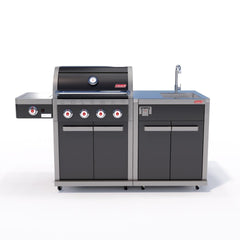
The Coleman Revolution 4 Burner Outdoor Kitchen is a good measure of how little space that takes. Coleman lists the barbecue at 143.4 cm wide on its Revolution 4 Burner kitchen page and each module at 69.5 cm on its sink module page. One module makes a 2,129 mm run and two make 2,824 mm. Mark that length on the paving, then check the manual's clearances around the barbecue; that is the whole brief for measuring your space before choosing.

A small outdoor kitchen works best when it does fewer things properly. In a courtyard, the question is not how many modules fit but which single one earns its place beside your barbecue. The barbecue's clearances then decide where the pair can stand.
For most small spaces, one module is enough: a sink if the cook keeps walking inside to rinse, a chilled module if the drinks are the bottleneck, or a storage cupboard if the tongs and covers have nowhere to live. The one-module Coleman run above is 2,129 mm long, but length is rarely what rules a courtyard out. Coleman's 91.4 cm clearance to anything combustible, together with its warning against windows and fences, can leave a small courtyard with no spot that meets the manual.
Balconies come with rules that backyards do not, most of them concerning gas. Western Australia's gas regulator, in its guide to safe locations for gas barbecues and patio heaters, allows a gas barbecue on a balcony or verandah only where it will not cause a hazard and the maker's instructions allow it. Where they do, it accepts the space if 20 per cent of the wall area stays permanently open. It also notes a 10 kg limit on LPG cylinders used or stored on a balcony. Coleman's manuals rule out a covered area such as a porch, the overhang of a building and any spot near windows, which excludes a roofed verandah and most balconies for its barbecues. Strata by-laws may add their own conditions, so read them before you buy anything that runs on gas.
An L shape separates the hot zone from the preparation zone without taking more space from the middle of the backyard. It is the layout that suits entertaining: the cook faces the garden from the barbecue, while whoever is chopping or pouring works around the corner, out of the smoke.
The Coleman Pro Series 5 Burner Outdoor Kitchen does this with a corner module that turns the run through ninety degrees. It also keeps the sink on the short leg, where it tends to be most useful. Set the L in the open corner of a terrace rather than in the corner of two house walls, where the barbecue would sit under the eaves and near windows. The barbecue belongs at the open end of the long leg.

A roof over the kitchen is the idea most owners reach for first. Several projects shared on the Bunnings Workshop forum close in a verandah or add side walls, in one case to shelter a fridge and fireplace that are not outdoor units. Walls protect the appliances from the weather, but enough of them can take a gas barbecue outside the rules.
Before any roof goes up, read the barbecue's manual. Coleman's manuals for its Revolution 4 Burner, Revolution Dual Fuel and Pro Series 5 Burner barbecues rule out three positions for lighting them: under a combustible object such as an awning; in a covered area such as a porch or gazebo; or under the overhang of a house, garage or other structure. For these kitchens the roof covers the people, not the barbecue. The prep, sink and fridge modules and the table sit under cover. The barbecue stands at the open end of the run, beyond the roof line and more than 91.4 cm from timber posts or anything else combustible.
The gas regulator's rules sit beneath the manual. Western Australia's guide says it does not take precedence over the manufacturer's instructions. Some makers do allow a barbecue under a roof; for those, the regulator treats a space as outdoors when it has four open sides under a roof, two walls under a roof, or three walls where the open side is at least 25 per cent of the perimeter and the other walls are 30 per cent open. It also asks for at least 1,200 mm between the cooking surface and the roof above. Each state applies its own gas rules, so ask a licensed gasfitter to assess any gas installation against the manual before the roof goes on.

The cabinets decide how long an outdoor kitchen lasts; no other choice of materials matters as much once the first wet winter has been through the joinery. Custom builds usually pair outdoor-rated cabinets with stone or porcelain benchtops, while a modular kitchen arrives with its benchtops already chosen.
Owners and cabinet makers report the same thing across forums: melamine and moisture-resistant MDF swell in outdoor humidity, even under a roof. In one Whirlpool thread on alfresco kitchens, the owner's own cabinet maker was reluctant to put standard white melamine outside for exactly that reason. A Bunnings Workshop moderator made the same point in 2026, noting that Kaboodle cabinetry is not warranted for exposed outdoor installations.
Coastal air is the other test of an outdoor kitchen's materials. The Australian Stainless Steel Development Association explains that grade 316 adds 2 per cent molybdenum for better corrosion resistance, while grade 304 suits parts that are frequently washed with fresh water. Coleman specifies 304-grade stainless for its module countertops, so in coastal suburbs within sight of the sea a regular fresh-water hose-down is part of owning one. That small habit is what keeps a coastal benchtop looking new.
A drinks cabinet built into the run stops the procession of people walking through the house for a cold drink. The detail that matters is whether the unit is rated for outdoor heat, because it will sit in a warm alfresco area all summer.
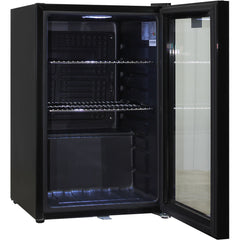
Coleman's tropical-grade fridge module holds 70 litres and is rated for hot weather. It is worth knowing that Coleman gives the module a 5 year limited warranty but the fridge inside it only 1 year. If you want more capacity or a freestanding unit, we cover venting and sizing in our outdoor bar fridge buying guide.

Not every outdoor kitchen needs gas. A charcoal barbecue with a matching cabinet gives the same working bench with no gas point to run, which suits a courtyard or a rental where plumbing work is not an option.
Aluvy's MARCEL charcoal barbecue has a 3,100 cm² cooking surface that Aluvy rates for 10 to 12 people. MARCEL also carries Origine France Garantie certification. The Aluvy JEAN kitchen cabinet attaches to either side as a work surface with two storage compartments. The pair reads as furniture rather than appliances, which is the point on a small terrace.

The oldest outdoor kitchen is a fire that cooks; building the kitchen around one gives the space a use through autumn and winter, long after the salads and cold drinks have gone inside.
The Buschbeck Rondo grills over charcoal, then takes logs as an open fireplace once dinner is done. Buschbeck lists four adjustable cooking heights and an optional pizza insert, in a unit 120 cm wide and about 510 kg, so it needs a solid, level base.
A wood-fired oven built into the end of a bench becomes the reason people gather. Our pizza ovens range runs from portable ovens to refractory kits that are built into masonry. Solid fuel comes with one rule to plan around: in New South Wales, a barbecue or pizza oven burning wood, charcoal or heat beads cannot be used outside during a Total Fire Ban, so a gas barbecue alongside keeps summer cooking going.

The idea that saves the most money is not visible in the finished kitchen. One homeone thread on outdoor kitchens includes advice to fix the gas outlet position and the place for the gas bottles while the house is still being built. Under a video of a flat-pack outdoor kitchen install, several commenters ask how the gas hose was routed and where the bottle is stored.
That work is licensed: in New South Wales, the government is clear that any plumbing, draining or gasfitting work needs a licence, whatever the cost of the job. Book the gasfitter, plumber and electrician for a site visit before choosing the run; the kitchen can then go where the services make it cheapest and the barbecue's manual allows it. If you send us photos of the space with the service points, the roof line and the windows marked, we will check the run against the manual before anything is ordered.
An outdoor kitchen is not the right answer for every yard. If the barbecue comes out a handful of times a year, a good freestanding barbecue and a sturdy bench will serve better than a built run for far less money. We would rather point you to that than sell you a kitchen that sits under a cover.
For those who cook outside every week, start the design with the barbecue's clearances, the services and a cabinet rated for the weather, then add cold drinks, a fire or an oven. Every outdoor kitchen from My Acre comes with our price-beat promise and owner's after-care: a fit check before anything ships, a shepherded delivery and a check-in within a week. We also handle the warranty for you. Ring Hayden on 03 7073 2116 and we will talk through your space before you choose, or browse the outdoor kitchens collection.

 Outdoor Kitchens
 Outdoor Kitchens
 Outdoor Kitchens

Want a written quote?
Tell me what you are after. I send it the same business day.
Great customer service - they rang me to tell me exactly when my bbq was coming, they also sent over the instructions and price honoured me. 10/10.
Great table delivered quickly! Very happy
We recently had a Serenity Cantilever umbrella installed and the My Acre team were fabulous. From initially advising us what would suit our tricky terrace best, to keeping us informed on delivery and installation and ...
Really happy with my Shadowspec Retreat wall-mounted umbrella. Hayden at My Acre has been great — always quick to respond and very helpful. I recently needed to make a small warranty claim, and Hayden organised everyt...
Thanks to the My Acre team delighted with the end product of the Umbrella cantilever shade. In all respects Hayden was fantastic details, invoicing, adjusting delivery to suit us and supporting the installation with a...
Australian owned · every order personally followed up