Short answer: Yes, slightly; the scent is mostly noticeable at two moments, when the flame is lit and when it goes out. EcoSmart describes a faint scent at ignition and extinguishing as normal. A smell that lingers during steady burning points to the wrong fuel, an object in the flame or a dirty burner.
If a brief, candle-like moment at lighting is acceptable to you, that is the whole answer. The rest covers what changes it and what the vanilla e-NRG variant does and does not promise; it also explains why smell is a poor test of air quality.
When does a bioethanol fire pit smell?
At the edges of the burn rather than the middle. EcoSmart's troubleshooting guide says a smell as the burner empties or just after it is switched off is normal, "just like when you blow out candles", while its fuel page describes a minimal, barely perceptible scent only at ignition and extinguishing.
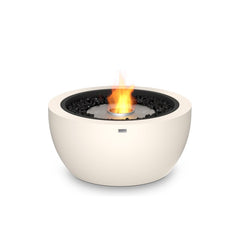
Take a hypothetical Saturday evening on a paved courtyard with an EcoSmart Pod 30. A guest catches a faint scent as the burner is lit and asks whether the fuel has gone off. It has not, because EcoSmart's Pod 30 specification lists 7 to 9 hours from its 8 L burner, so the second whiff arrives hours later when the fuel runs low or the host closes the burner. A host who knows where the scent comes from is far less likely to blame the fuel, then switch to something unapproved that really does leave residue.
Owners describe the same pattern, with caveats. On a UK building forum, one poster who used a bioethanol stove indoors gave it up over a faint chemical smell and moved it outside, where the smell bothered them less. Another poster on the same thread noticed nothing during the burn but a strong smell when the slider closed. A member of a cycling forum says theirs has a slight smell, less than a wood burner; all three are UK owners, mostly indoors, so they describe a stricter test than an open-air pit.
What makes the smell stronger?
EcoSmart lists three causes for a foreign smell during burning: waste burning in the burner, the wrong fuel, or something placed around or above the flame that has not been approved. Each is avoidable, since EcoSmart's safety instructions say never to use any fuel other than e-NRG. Its fuel page adds that isopropyl alcohol and denatured spirits leave residue in the burner and that gel fuels void the burner warranty.
Spilt fuel is the other common source of smell, noticeable even before the pit is lit. EcoSmart says to wipe up spills immediately with a dry cloth followed by a damp one, then to let the area dry completely before lighting. Queensland Fair Trading adds that the burner should not be used until all fumes and traces of fuel have left the room.
A burner that smells unusually strong after long use is usually dirty. EcoSmart's essential guide says to wait until the burner is at room temperature, wash it in hot soapy water, rinse it and dry it fully before it goes back into the pit. My Acre's guide to cleaning a fire table sets out the monthly burner clean.
Does the vanilla e-NRG fuel smell different?
It is meant to. e-NRG's own site lists a vanilla variant described as bioethanol fuel infused with soft vanilla aromatic notes. My Acre stocks both the unscented fuel and the vanilla-scented fuel.
The honest limit is evidence. e-NRG's page does not say how strong the scent is, whether it covers the lighting smell, or whether it burns differently. No independent comparison turned up in the research for this guide. Never add fragrance oil to the fuel or the burner to get a similar effect, because EcoSmart's safety instructions allow e-NRG only. If scent matters to your household, ring before you buy and I will say what I know and what I do not.
Is a lack of smell proof that the air is clean?
No. Smell is a poor test of what a flame releases. A 2026 journal study, summarised on ScienceDirect, tested a flueless bioethanol fireplace indoors under minimal ventilation. The authors report that formaldehyde and nitrogen dioxide often exceeded WHO short-term guideline values, which led them to conclude that such fireplaces "can markedly deteriorate" indoor air quality.
That study measured a room rather than an open-air pit, so it does not describe a pit on a patio with the sky above it. It is the reason My Acre treats open air as the first rule, so the faint scent is never offered as evidence of clean combustion. Under a roof or behind blinds a pit has less air to disperse into, which is our reading rather than a measured result; the piece on a fire table under a covered patio holds the clearances.
How does it compare with wood smoke?
Wood smoke is a different smell with a different cause; that comparison belongs in the smokeless fire pit guide. Whether the fuel itself smells, mostly indoors, is covered in are bioethanol fireplaces any good.
For an outdoor pit the practical comparison is short. EcoSmart describes the Pod 30's flame as smokeless, which leaves no smoke to drift over a neighbour's fence or into the washing; the scent that remains is brief.
What should you do about it?
Use only e-NRG; keep anything unapproved out of the flame; wipe spills before lighting; clean the burner when it starts to smell. EcoSmart's lighting and shut-off steps are set out in how to light a bioethanol fire table.
A bioethanol fire pit suits anyone who wants a real flame without the smoke, ash and lingering smell of a wood fire, provided a brief scent at lighting is acceptable. The exception is a pit that must sit in a closed space, or a household that cannot tolerate any scent at all; there a different heat source is the honest answer. Browse the ethanol fire pits, then ring me on 1300 515 620 before you buy. Every pit carries our price-beat promise; we also handle any warranty claim for you.
You May Also Like:
About the author:
“I have a real passion for helping transform outdoor spaces so people can relax, connect and entertain with confidence and pride. With My Acre, I love guiding homeowners to create beautiful and functional outdoor living areas."