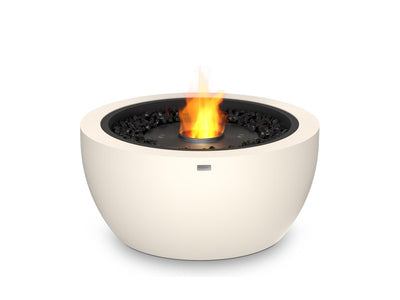
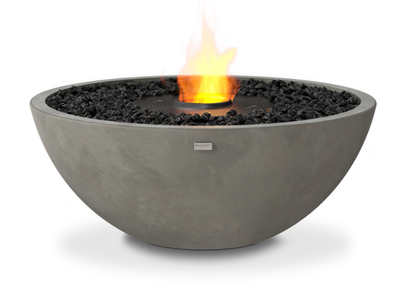
Short answer: Yes, for what they are actually built to do: a real flame, indoors or out, with no flue and no gas line. They are not a substitute for a wood fire’s raw heat or a gas heater’s running cost. The honest scepticism people bring to them, about warmth, running cost and fuel smell, mostly has a real basis rather than being a myth to talk buyers out of.
Have a look through our own EcoSmart Fire range while you weigh this up.
Is the flame too weak to bother with?
That scepticism is both real and fair. A single AB3 burner produces 5,800 BTU/hr, roughly 1.7 kW, while the larger AB8 tops out at 20,433 BTU/hr, around 6 kW. EcoSmart Fire’s own sizing guide says plainly that these fireplaces are “not designed to replace a building’s central heating,” and describes them as a supplemental heat source rather than a primary one. That confirms the sceptics rather than contradicting them: a bioethanol fireplace warms the seating zone around it well, but it will not carry a whole living room through a Canberra winter on its own.
Does it actually cost more to run than people expect?
Yes: that worry is justified rather than exaggerated. Independent testing from CHOICE Australia found that a litre of bioethanol fuel gives roughly 90 minutes to two hours of burning on a high setting. CHOICE puts the cost of that heat well above the same amount from mains gas. EcoSmart’s own fuel-cost guide concedes the same point directly: bioethanol “won’t beat mains gas on raw cost per hour.” What that comparison leaves out is installation: a bioethanol fireplace has no flue, no gas connection and no servicing contract behind it, so the fairer comparison for your own household is total cost over a season, not the bare per-hour figure.
Does the fuel really smell?
Sometimes it does, though the cause is usually easy to trace. My Acre’s own guidance on running costs is direct about this: lower-purity fuels bought cheaply from a servo or hardware shelf “can burn shorter and smell,” and running anything other than e-NRG voids the EcoSmart warranty in the process. Genuine e-NRG bioethanol is formulated to burn without the smell that gives the whole category a bad name secondhand. The complaint is usually about the fuel poured into the burner, not the burner itself.
Is the heat really weaker than a wood fire?
Yes, measurably. EcoSmart’s own comparison table puts a wood fire pit at 30,000 to 60,000 BTU/hr against 5,800 to 20,433 BTU/hr for bioethanol, a real and large gap rather than a rounding difference. Bioethanol trades that raw output for cleaner combustion, with none of the smoke, soot or ember risk of an open wood fire.
The honest verdict
A bioethanol fireplace is good at exactly what it claims to be: a clean, flueless, real flame that costs more per hour than gas and puts out less raw heat than wood. Buy it for the ambience and the useful heat dividend it gives you, not as a primary heater. The scepticism above then stops being a warning sign and starts being an accurate description.
Every EcoSmart fireplace ships with free delivery. If you find the same fireplace cheaper elsewhere, we will beat that price. Hayden sizes the burner to your actual room before anything ships, follows up within a week of delivery, and handles any warranty claim on your behalf afterwards. Browse EcoSmart Fire, or get a quote and talk it through before you commit to anything. Ring 1300 515 620 if a conversation beats a form.
You May Also Like:
About the author:
“I have a real passion for helping transform outdoor spaces so people can relax, connect and entertain with confidence and pride. With My Acre, I love guiding homeowners to create beautiful and functional outdoor living areas."