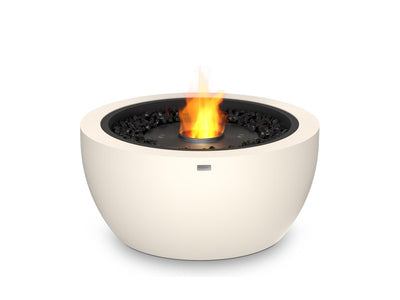
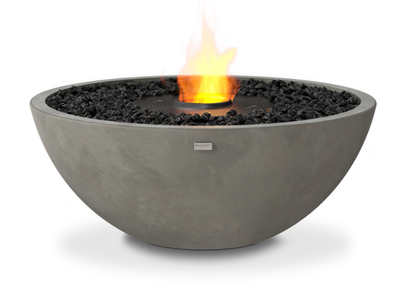
Short answer: A bioethanol fireplace costs more per hour than mains gas and tops out at 6 kW from a single burner, well below what a wood fire can throw. It also needs its fuel bought and stored under real Dangerous Goods rules. None of that is disqualifying, but a fair buying decision needs all four downsides stated plainly, not glossed over in favour of the clean-burning pitch.
See how the EcoSmart Fire range handles each of these before you rule it in or out.
Running cost is real, never free
Fuel is the only running cost a bioethanol fireplace carries, which sounds like an advantage until the real number lands. EcoSmart Fire, the maker of the burner range My Acre sells, concedes the point directly in its own running-cost guidance: bioethanol “won’t beat mains gas on raw cost per hour.” My Acre’s own published figures put that cost at roughly $2.00 an hour on a compact AB3 burner, rising to $7.60 an hour on the larger AB8 at full flame. That is litres of e-NRG fuel multiplied by the price paid per litre. There is no standing charge; no bill lands when the fire stays off. Every hour you do burn it, that hour still carries a real dollar figure, one that runs higher than the equivalent hour of mains gas.
Heat output has a genuine ceiling
A single bioethanol burner cannot match what a wood fire is capable of throwing. The largest single burner EcoSmart sells, the AB8, tops out at 20,433 BTU/hr, around 6 kW; the smaller AB3 manages 5,800 BTU/hr, roughly 1.7 kW. A wood fire pit, by contrast, runs anywhere from 30,000 to 60,000 BTU/hr, or 9 to 18 kW, depending on how it is loaded. EcoSmart’s own documentation states the ceiling without hedging: these fireplaces are “not designed to replace a building’s central heating.” Treat a bioethanol fireplace as ambience with a genuine heat dividend, never as the thing standing between your living room and a cold night.
Fuel has to be bought and stored under real rules
Bioethanol fuel is classified as a Dangerous Goods Class 3 flammable liquid; that classification carries actual storage limits rather than a vague safety suggestion. EcoSmart’s own compliance guidance sets the thresholds plainly. Storing more than 20 litres indoors can trigger a permit requirement. Anything above 40 litres needs an approved flammable storage cabinet. That is not a large volume for a household that lights the fire often. If you buy cartons in bulk to save on delivery, check what you are actually storing in your own cupboard, before convenience quietly becomes a compliance problem.
The flame looks and behaves differently from wood
A bioethanol flame is real fire, but it is not the same experience as an open wood fire. Expect a like-for-like swap and the first evening is usually a disappointment. EcoSmart’s own comparison against wood fire pits is candid about what is missing: “if it’s a weekend gathering around something that smells like every memory of a fire you’ve ever had, the answer leans wood.” There is no crackle, no shower of sparks and none of the woodsmoke smell that clings to a jacket long after the fire is out. What is left is a smaller, steadier, more contained flame, which some buyers find they actually prefer once they stop expecting it to behave like a campfire.
Why the safety standard exists in the first place
The strongest independent evidence against treating any of this casually comes from the ACCC’s own paper on decorative alcohol-fuelled devices, published ahead of the mandatory standard that now governs every unit sold in Australia. Since 2010, the ACCC recorded at least 113 reported incidents involving these devices, linked to 105 injuries and 36 house fires. Most happened during or immediately after refuelling. That data is exactly why the current mandatory standard requires a minimum weight and footprint, a stability test and a fuel container with a flame arrester or automatic pump. It is also why the single most dangerous moment with any bioethanol fireplace is refuelling a unit that has not properly cooled; the flame itself, once burning normally, is rarely where the real risk sits. A certified model bought through a reputable seller closes most of that gap; carelessness during refuelling can still reopen it regardless of certification.
The honest verdict
None of these four downsides makes a bioethanol fireplace a poor choice. They make it the wrong choice for anyone expecting free heat, a wood fire’s raw output, unlimited fuel with no storage thinking involved, or a crackling campfire indoors. For anyone who wants a clean, flueless, real flame and already understands what it costs to run, the trade-offs above are simply the honest terms of the deal.
Every EcoSmart fireplace ships with free delivery. If you find the same fireplace cheaper elsewhere, we will beat that price. Hayden talks through running cost and room size for your actual space before anything ships, follows up within a week of delivery, and handles any warranty claim on your behalf afterwards. Browse EcoSmart Fire, or get a quote before you commit to anything. Ring 1300 515 620 if a conversation beats a form.
You May Also Like:
About the author:
“I have a real passion for helping transform outdoor spaces so people can relax, connect and entertain with confidence and pride. With My Acre, I love guiding homeowners to create beautiful and functional outdoor living areas."