

Lisa B
★★★★★
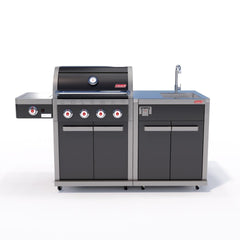
10 Nov 2026Great customer service - they rang me to tell me exactly when my bbq was coming, they also sent over the instructions and price honoured me. 10/10.
Price beat promise

Most chosen
Not sure which one?
Hayden, co-owner
Tell me about your space and I will point you to the right fire. I reply the same business day.
Call 03 7073 2116Most chosen
Not sure which one?
Hayden, co-owner
Tell me what you love to cook and I will point you to the right setup. I reply the same business day.
Call 03 7073 2116Most chosen
Not sure which one?
Hayden, co-owner
Tell me the area you want to shade and I will point you to the right size. I reply the same business day.
Call 03 7073 2116Ponds and fountains
FountainsPondless waterfallsPond kitsDam aerators and fountainsPond filters and equipmentPool care
Robotic pool cleanersBrands
AquascapeAtlas FiltriBBA BiosolutionBeatbotBiancoClayTechDAB PumpsElevateKellockOaseOtterbinePietro StonewareRobo-TekWater MasterNot sure which one?
Hayden, co-owner
Tell me what you need the water to do and I will point you to the right pump, filter or water feature. I reply the same business day.
Call 03 7073 2116Where to start
Not sure which one?
Hayden, co-owner
Tell me what you are planning and I will point you to the right fit. I reply the same business day.
Call 03 7073 2116Spas
Spas and hot tubsComingSwim spasComingNot sure which one?
Hayden, co-owner
Tell me how you want to relax and I will point you to the right spa or sauna. I reply the same business day.
Call 03 7073 2116Not sure which one?
Hayden, co-owner
Tell me what you are planning and I will point you to the maker that suits it. I reply the same business day.
Call 03 7073 2116
Fire
Most chosen
Outdoor Kitchens
Most chosen
Shade
Most chosen
Water
Ponds and fountains
FountainsPondless waterfallsPond kitsDam aerators and fountainsPond filters and equipmentPool care
Robotic pool cleanersGarden
Where to start
Spas & Saunas
Spas
Spas and hot tubsComingSwim spasComingBrands
About
Who we are
Who is My Acre?Why My Acre?Meet Hayden and TimOur installersContact usWhat we promise
Price beat promiseShipping and deliveryWarranty and claimsReturns and exchangeGuides and resources
Customer resourcesCustomer reviewsBlogs


Short answer: Size a fire fighting pump by the work it must do, not by engine size alone. The written minimum in NSW and South Australia for new homes in bushfire areas is a petrol or diesel pump of about 5 hp (3 to 3.7 kW). Above that, choose by head: suction lift, plus the height to the roofline, plus a pressure margin. Water Master recommends a maximum pressure above 100 PSI, about 70 m of head.
That covers most single-house blocks. The sections below explain where those minimums come from, how to calculate head and flow for your property, why hose size changes the answer and where a bigger pump will not help. The pumps mentioned are in our fire fighting pumps collection.
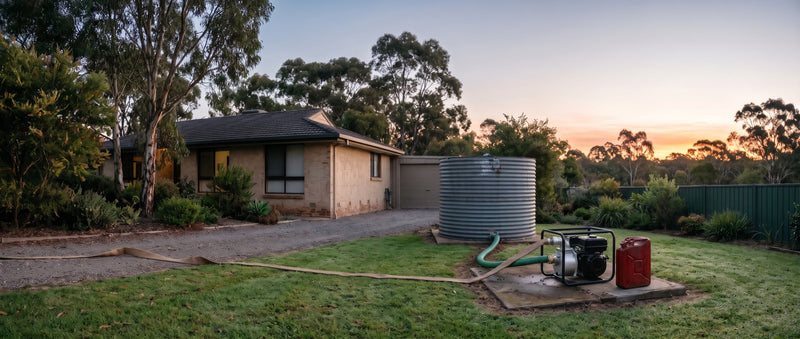
For a typical home on a bushfire-prone block, a portable petrol or diesel fire pump of around 5 to 6.5 hp with a 1.5 inch (38 mm) suction satisfies the written minimums; the head calculation below decides the particular model. Larger engines and twin impellers justify their extra cost only where the block is steep, the hose runs are long or several outlets operate simultaneously.
Victoria's Country Fire Authority publishes no single figure. Instead it lists the variables that determine the size: the location and distance of the water source, the size and layout of the pipes, the number of outlets operating at once (sprinklers included), the size and length of the hoses and the choice between diesel and petrol. Those five variables are the sizing method; the rest of this guide works through them.
Two states write a minimum pump into their bushfire building requirements. In New South Wales, the RFS document Planning for Bush Fire Protection 2019 states that where pumps are provided, they should be at least a 5 hp or 3 kW petrol or diesel pump, shielded against bush fire attack, with any connected hose and reel of 19 mm internal diameter.
South Australia's Ministerial Building Standard MBS 008 (July 2020) specifies a pump with a minimum 38 mm inlet and a power rating of at least 3.7 kW (5 hp), operating on petrol, diesel or another approved power source independent of mains electricity. The same standard requires the pump to remain operable throughout the fire danger season and on fire ban days.
Both documents apply to new homes and substantial extensions in designated bushfire areas, so an existing house may not be bound by them. They remain a sensible floor if you are choosing a pump for an older home. The local council, or the fire service in each state, is the authority on what applies to your block. Our guide to whether backyard fires are legal in NSW covers the separate rules on lighting fires.
Add the suction lift to the vertical distance the water must climb, then allow a generous margin for pressure at the nozzle. Water Master's guide to choosing a water pump illustrates the calculation: drawing water up 5 m and delivering it to a point 25 m above the pump requires a maximum head greater than 30 m. The guide explains that pressure falls to zero at a pump's maximum head, so a pump rated exactly at the required height has no pressure remaining at the top.
For firefighting, the same guide recommends a maximum pressure above 100 PSI and supplies the conversion: multiply maximum head by 1.42 to obtain PSI. Working backwards, 100 PSI corresponds to a maximum head of approximately 70.4 m. As a signposted example, consider a tank 2 m below the pump inlet on a sloping block, with the roof ridge 10 m above the pump. The total lift is 12 m before hose friction, so the remaining head is what provides throw and pressure at the nozzle.
The published figures for the pumps we stock compare as follows. Each maximum is the manufacturer's figure measured at the pump; pressure is calculated with Water Master's 1.42 conversion.
| Pump (maker figures) | Max head and pressure | Max flow |
|---|---|---|
| Water Master MH215-SHP, Honda GX200, single impeller | 74.5 m, about 105.8 PSI | 570 L/min |
| Bianco Vulcan HP15ABS, Briggs & Stratton 6.5 HP, single | 60 m, about 85.2 PSI | 325 L/min |
| Bianco Vulcan 2HP15ABS, same engine, twin impeller | 80 m, about 113.6 PSI | 300 L/min |
| Water Master MYD15HPE, Yanmar L70N diesel, single | 60 m, about 85.2 PSI | 640 L/min |
Sources: the Water Master MH215-SHP page, Bianco's Vulcan manual and the Water Master MYD15HPE page. Water Master states on both product pages that actual performance depends on suction head, static head and friction head. Measured against Water Master's 100 PSI recommendation, the MH215-SHP and the twin impeller Vulcan clear the mark; the single impeller Vulcan and the diesel fall short of it, which suits them to flatter blocks and shorter runs.
Enough for every outlet you will open at once, after suction losses. Bianco's manual quantifies how quickly suction reduces flow: a pump generating 3 m of suction delivers approximately 80% of its rated flow, while one generating 5 m delivers approximately 68%. On the Bianco Vulcan HP15ABS, that reduces 325 L/min to roughly 260 L/min at 3 m of lift and 221 L/min at 5 m.
Sprinklers change the calculation considerably. A poster on The Grey Nomads Forum describes conventional impact sprinklers as very water hungry and in need of a substantial pump. In a long Whirlpool thread on backup power for pumps, an owner operating hoses plus roof and riser sprinklers reports that an everyday household pump does not cope. Count every sprinkler head as an outlet, then confirm that the pump's flow at your calculated head still covers them.
Flow also determines how long the water lasts. The CFA asks for at least 10,000 litres to defend a property; at the 570 L/min maximum of the Water Master MH215-SHP, that represents about 17.5 minutes of running time. A larger pump empties the same tank faster, which is why the water supply frequently limits a system before the pump does.
Yes, more than you might anticipate. Bianco's manual specifies a suction line equal in diameter to the pump inlet, or one size larger, kept as short and straight as possible. It also states that the discharge pipe should not be smaller than the pump discharge. Long, narrow hose wastes pressure the pump has generated.
Owners report the same experience. A commenter on a YouTube video titled Fire Pump Basics warns that a long 3/4 inch hose reel greatly reduces a pump's performance. An owner on ExplorOz runs 40 mm pipe all the way to the roof peak specifically to prevent pressure drop.
Only if the head calculation demands it. A twin impeller adds head at the expense of a little flow; the comparison is set out in our guide to single vs twin impeller fire fighting pumps. The choice between petrol, diesel and electric operation is covered in electric vs petrol fire fighting pumps.
A bigger pump cannot compensate for a limited water supply, an excessively long hose or a plan that depends on staying. The CFA states that its advice does not guarantee survival; the best chance is leaving the night before or early in the morning on Extreme or Catastrophic days. Maintenance is the other weakness. A poster on The Grey Nomads Forum who house-sits rural properties says not one property visited had a serviceable, portable firefighting setup.
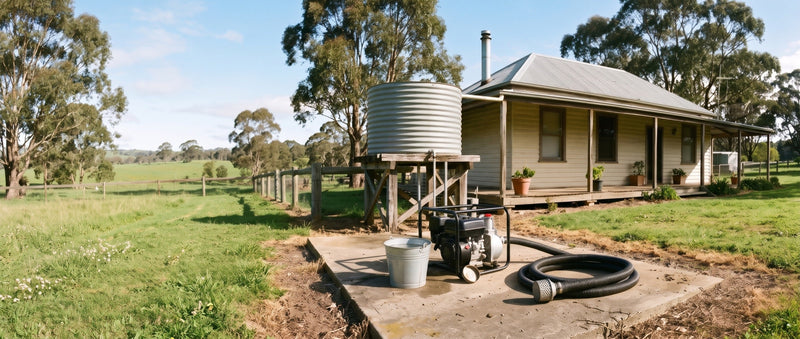
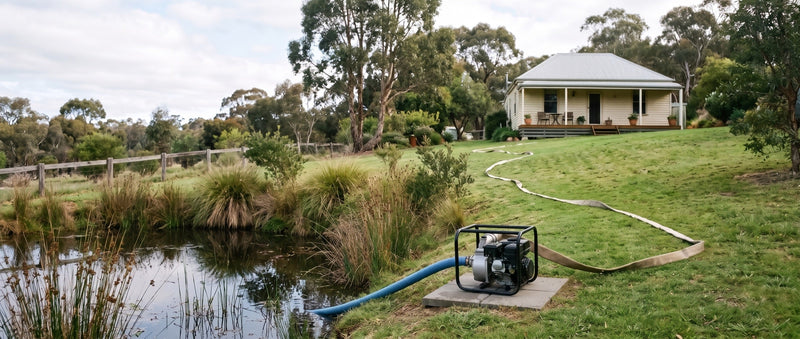
Picture a weatherboard house on a gentle slope, with the CFA's 10,000 litres in a tank behind the shed and a long hose run to the far side of the verandah. The owner buys the largest engine available, then discovers on test day that a long, narrow garden hose reel leaves little pressure at the nozzle. With a 5 to 6.5 hp pump, suction hose matched to the inlet and proper fire hose, the same tank delivers water to the gutters at useful pressure. The right size is the smallest pump that clears the required head with a margin.
That sometimes means less pump than expected; I will say so. Ring me on 03 7073 2116 with the height from your water to your roofline, the hose length and the sprinklers you run; I will match a pump to those numbers. The Water Master MH215-SHP is $1,354 and the Bianco Vulcan HP15ABS is $1,349 at our prices on 9 November 2026. Both carry our price-beat promise. We handle warranty for you, while delivery is charged by state at checkout.

 Water Pumps
 Water Pumps
 Water Pumps

Want a written quote?
Tell me what you are after. I send it the same business day.
Great customer service - they rang me to tell me exactly when my bbq was coming, they also sent over the instructions and price honoured me. 10/10.
Great table delivered quickly! Very happy
We recently had a Serenity Cantilever umbrella installed and the My Acre team were fabulous. From initially advising us what would suit our tricky terrace best, to keeping us informed on delivery and installation and ...
Really happy with my Shadowspec Retreat wall-mounted umbrella. Hayden at My Acre has been great — always quick to respond and very helpful. I recently needed to make a small warranty claim, and Hayden organised everyt...
Thanks to the My Acre team delighted with the end product of the Umbrella cantilever shade. In all respects Hayden was fantastic details, invoicing, adjusting delivery to suit us and supporting the installation with a...
Australian owned · every order personally followed up