

Lisa B
★★★★★
10 Nov 2026Great customer service - they rang me to tell me exactly when my bbq was coming, they also sent over the instructions and price honoured me. 10/10.
Price beat promise

Most chosen
Not sure which one?
Hayden, co-owner
Tell me about your space and I will point you to the right fire. I reply the same business day.
Call 03 7073 2116Most chosen
Not sure which one?
Hayden, co-owner
Tell me what you love to cook and I will point you to the right setup. I reply the same business day.
Call 03 7073 2116Most chosen
Not sure which one?
Hayden, co-owner
Tell me the area you want to shade and I will point you to the right size. I reply the same business day.
Call 03 7073 2116Ponds and fountains
FountainsPondless waterfallsPond kitsDam aerators and fountainsPond filters and equipmentPool care
Robotic pool cleanersBrands
AquascapeAtlas FiltriBBA BiosolutionBeatbotBiancoClayTechDAB PumpsElevateKellockOaseOtterbinePietro StonewareRobo-TekWater MasterNot sure which one?
Hayden, co-owner
Tell me what you need the water to do and I will point you to the right pump, filter or water feature. I reply the same business day.
Call 03 7073 2116Where to start
Not sure which one?
Hayden, co-owner
Tell me what you are planning and I will point you to the right fit. I reply the same business day.
Call 03 7073 2116Spas
Spas and hot tubsComingSwim spasComingNot sure which one?
Hayden, co-owner
Tell me how you want to relax and I will point you to the right spa or sauna. I reply the same business day.
Call 03 7073 2116Not sure which one?
Hayden, co-owner
Tell me what you are planning and I will point you to the maker that suits it. I reply the same business day.
Call 03 7073 2116
Fire
Most chosen
Outdoor Kitchens
Most chosen
Shade
Most chosen
Water
Ponds and fountains
FountainsPondless waterfallsPond kitsDam aerators and fountainsPond filters and equipmentPool care
Robotic pool cleanersGarden
Where to start
Spas & Saunas
Spas
Spas and hot tubsComingSwim spasComingBrands
About
Who we are
Who is My Acre?Why My Acre?Meet Hayden and TimOur installersContact usWhat we promise
Price beat promiseShipping and deliveryWarranty and claimsReturns and exchangeGuides and resources
Customer resourcesCustomer reviewsBlogs


Short answer: A twin impeller fire fighting pump feeds water through two impellers in series, so it builds more pressure but moves slightly less water. Bianco's two 6.5 HP Vulcan pumps show the trade on the same engine: the single impeller model reaches 60 m of head and 325 L/min, the twin reaches 80 m and 300 L/min. Choose twin if you need height and distance, single if you need volume.
Where the water supply and the house sit on roughly level ground, a single impeller pump is usually the better purchase, so a reader in that position can stop here. The sections below explain the mechanism, the common belief that twin means more water and why engine size can matter more than impeller count.
The difference lies in the number of pressure stages the water passes through. An impeller is the rotating disc inside a centrifugal pump that throws water outward and builds pressure. In a twin impeller pump, the discharge of the first impeller feeds the intake of the second, an arrangement US Fire Pump describes as operating in series, used to generate higher pressure at a given shaft speed.
Bianco's manual for the Vulcan range describes the distinction in practical terms. The HP15ABS is a single impeller pump described as a versatile all-round performer, while the 2HP15ABS is a twin impeller model delivering higher pressure for longer hose runs, steeper terrain or situations needing extra throw. Both share the same 6.5 HP Briggs & Stratton engine, aluminium wet end and 1.5 inch suction.
No. On Bianco's published figures the twin impeller model delivers 25 L/min less maximum flow than the single, in exchange for 20 m more head.
| Bianco Vulcan model | Impeller type | Max head / max flow |
|---|---|---|
| HP15ABS | Single closed | 60 m / 325 L/min |
| 2HP15ABS | Twin closed | 80 m / 300 L/min |
The belief that twin means more water still circulates among owners. On the ExplorOz forum, one buyer assumes a twin does twice the work; the replies that follow concern pressure rather than volume. Twin buys reach, not quantity.
When the calculated head for your property exceeds what a single impeller pump can deliver with a comfortable margin for nozzle pressure. Water Master's guide to choosing a water pump recommends a maximum pressure above 100 PSI for firefighting and converts head to pressure by multiplying by 1.42. By that measure the twin Vulcan, at about 113.6 PSI, clears the recommendation; the single Vulcan, at about 85.2 PSI, does not.
That extra pressure carries a practical risk. One owner in the ExplorOz thread reports a twin impeller pump blowing a poly fitting when a tap was closed, even 1,200 m from the dam; another chose a single impeller to avoid bursting house pipework if a sprinkler valve was left shut. Fit valves and fittings rated for the pressure you will run before you choose twin.
On flatter blocks, for short hose runs, or where a larger engine is available. Engine capacity alters the comparison considerably. The Water Master MH215-SHP is a single impeller pump with a Honda GX200 engine, listed at 74.5 m of head and 570 L/min, which Water Master says few single impeller pumps of its weight can match. That is more head than the single Vulcan and nearly double the twin Vulcan's flow.
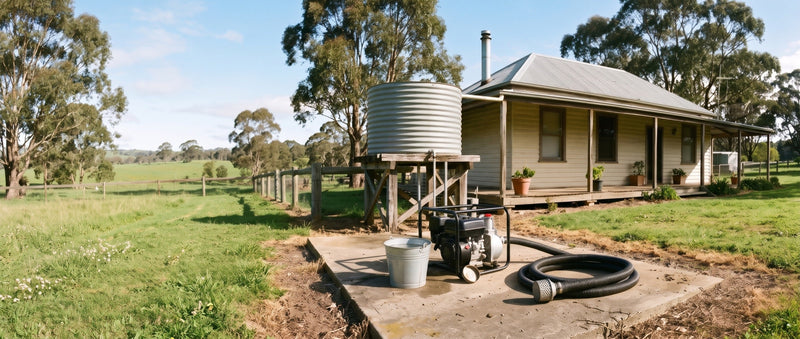
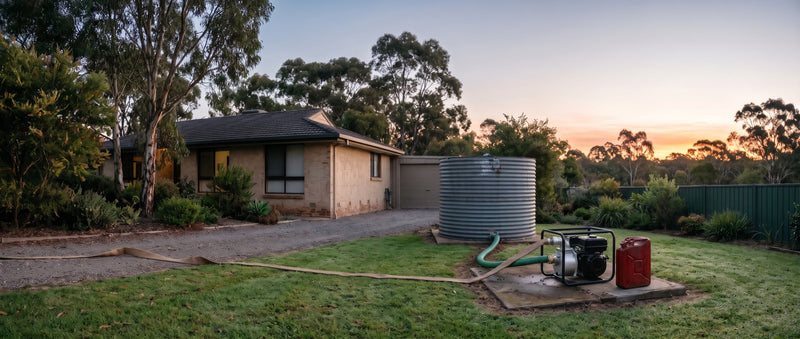
Two owners in the same ExplorOz thread who run single impeller pumps describe plenty of volume and pressure for their needs, including burning off from a trailer tank. Picture a brick home on a flat quarter-acre block, a tank beside the shed and 30 m of hose to the back fence: the extra 20 m of head from a twin impeller would never be used, while the extra flow of a single would put more water on a spot fire.
Ask for the complete performance curve rather than the two maximums alone, then read it at the head your property requires. Water Master notes that its figures are measured at the pump and that suction, static and friction head all affect real performance. If the curves intersect near the required duty point, either pump will serve; if the required head sits well above 60 m, the twin justifies its additional cost.
At our prices on 9 November 2026 the Bianco Vulcan HP15ABS is $1,349, the twin 2HP15ABS is $1,539 and the Water Master MH215-SHP is $1,354. The twin is the only twin impeller pump we stock, so if a property needs more head than it offers, we will recommend another manufacturer rather than sell the wrong pump. The Water Master range is single impeller throughout. Ring me on 03 7073 2116 with the height and distance your water must travel; every pump carries our price-beat promise and we handle warranty for you.

 Water Pumps
 Water Pumps
 Water Pumps

Want a written quote?
Tell me what you are after. I send it the same business day.
Great customer service - they rang me to tell me exactly when my bbq was coming, they also sent over the instructions and price honoured me. 10/10.
Great table delivered quickly! Very happy
We recently had a Serenity Cantilever umbrella installed and the My Acre team were fabulous. From initially advising us what would suit our tricky terrace best, to keeping us informed on delivery and installation and ...
Really happy with my Shadowspec Retreat wall-mounted umbrella. Hayden at My Acre has been great — always quick to respond and very helpful. I recently needed to make a small warranty claim, and Hayden organised everyt...
Thanks to the My Acre team delighted with the end product of the Umbrella cantilever shade. In all respects Hayden was fantastic details, invoicing, adjusting delivery to suit us and supporting the installation with a...
Australian owned · every order personally followed up