

Lisa B
★★★★★
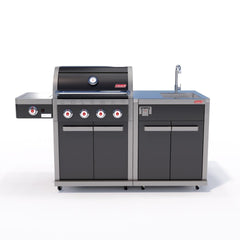
10 Nov 2026Great customer service - they rang me to tell me exactly when my bbq was coming, they also sent over the instructions and price honoured me. 10/10.
Price beat promise

Most chosen
Not sure which one?
Hayden, co-owner
Tell me about your space and I will point you to the right fire. I reply the same business day.
Call 03 7073 2116Most chosen
Not sure which one?
Hayden, co-owner
Tell me what you love to cook and I will point you to the right setup. I reply the same business day.
Call 03 7073 2116Most chosen
Not sure which one?
Hayden, co-owner
Tell me the area you want to shade and I will point you to the right size. I reply the same business day.
Call 03 7073 2116Ponds and fountains
FountainsPondless waterfallsPond kitsDam aerators and fountainsPond filters and equipmentPool care
Robotic pool cleanersBrands
AquascapeAtlas FiltriBBA BiosolutionBeatbotBiancoClayTechDAB PumpsElevateKellockOaseOtterbinePietro StonewareRobo-TekWater MasterNot sure which one?
Hayden, co-owner
Tell me what you need the water to do and I will point you to the right pump, filter or water feature. I reply the same business day.
Call 03 7073 2116Where to start
Not sure which one?
Hayden, co-owner
Tell me what you are planning and I will point you to the right fit. I reply the same business day.
Call 03 7073 2116Spas
Spas and hot tubsComingSwim spasComingNot sure which one?
Hayden, co-owner
Tell me how you want to relax and I will point you to the right spa or sauna. I reply the same business day.
Call 03 7073 2116Not sure which one?
Hayden, co-owner
Tell me what you are planning and I will point you to the maker that suits it. I reply the same business day.
Call 03 7073 2116
Fire
Most chosen
Outdoor Kitchens
Most chosen
Shade
Most chosen
Water
Ponds and fountains
FountainsPondless waterfallsPond kitsDam aerators and fountainsPond filters and equipmentPool care
Robotic pool cleanersGarden
Where to start
Spas & Saunas
Spas
Spas and hot tubsComingSwim spasComingBrands
About
Who we are
Who is My Acre?Why My Acre?Meet Hayden and TimOur installersContact usWhat we promise
Price beat promiseShipping and deliveryWarranty and claimsReturns and exchangeGuides and resources
Customer resourcesCustomer reviewsBlogs


Short answer: For bushfire defence, choose petrol or diesel. Victoria's CFA expects mains power to fail during a bushfire and lists a non-electrical firefighting pump among the minimum equipment for defending a property. An electric pump works only with a generator able to start and run it. Petrol costs less and weighs less; diesel runs longer and its fuel is less flammable.
If the property already has a suitable petrol pump, nothing here should change that. The sections below cover why electric pumps fail in a fire, what a generator setup really demands, how petrol and diesel compare on our own range and how to protect whichever engine you choose.
Not as the main pump. The Country Fire Authority expects mains power to be lost during a bushfire, so an electric pump needs a generator capable of starting and running it. Its minimum list for defending a property names a non-electrical firefighting pump protected from radiant heat, alongside at least 10,000 litres of water.
Water utilities give the same advice. Barwon Water and Westernport Water both recommend considering a non-electrical pump because power is not guaranteed during a bushfire; both also warn about the risks associated with flammable fuels. South Australia's Ministerial Building Standard MBS 008 (July 2020) makes it a rule for new homes in bushfire areas: the pump must run on petrol, diesel or another approved source that works without mains power.
Yes, if the generator can start the motor. Starting takes far more power than running. Posters in two Whirlpool threads, one on electric fire pumps and one on backup generators, describe motor starting loads several times the running load. One owner in the first thread reports that a 5 kVA diesel generator only just starts a 2,400 W electric pump.
The bigger worry is that it may not start. Across both Whirlpool threads and an ExplorOz discussion, owners keep coming back to a dedicated petrol fire pump. They call a generator and electric pump two points of failure and too clumsy to move in a fire. Water Master's guide to choosing a pump puts the choice the same way: a generator to power an electric pump, or the simpler solution of an engine-powered fire pump.
Petrol suits a portable pump at a moderate price; diesel suits a pump that stays in place and runs for long periods. Water Master's guide states that petrol models cost less and come in more models, while diesel models are more fuel efficient and better suited to extended running, but more expensive. It adds that diesel is less flammable than petrol, so it can be safer.
Our own range shows how far apart the two sit. Both are single impeller Water Master pumps with a 1.5 inch suction; figures are from the maker's pages for the petrol MH215-SHP and the diesel MYD15HPE.
| Maker figure | Petrol: Honda GX200 (MH215-SHP) | Diesel: Yanmar L70N (MYD15HPE) |
|---|---|---|
| Starting | Recoil | Electric, battery in frame |
| Weight | 27 kg | 70 kg |
| Max head / max flow | 74.5 m / 570 L/min | 60 m / 640 L/min |
| Our price, 9 November 2026 | $1,354 | Quoted on request, with freight |
The diesel weighs more than two and a half times as much and is sold by quote, with freight priced to your address. It is a pump to install and leave, with electric start that anyone on the property can operate. The petrol pump moves to the tank, pool or dam where it is needed, carried by two people.
Stale fuel is the failure that makers and owners warn about most, whichever engine you choose. The CFA's pre-season checklist tells households to replace old fuel because it can stop a pump working properly. Bianco's manual for its Vulcan petrol fire pumps specifies fresh 91-octane unleaded, rules out ethanol blends above 10% and says storing the pump with fuel in the tank for long periods is not recommended, because stale fuel clogs the fuel lines and carburettor.
Owners describe the same pattern independently. In the backup generator thread on Whirlpool, a poster puts fuel at the root of nearly every small-engine failure and advises against E10. A poster in the electric pump thread warns that petrol engines dislike sitting with stale fuel. On ExplorOz, an owner avoids ethanol fuel entirely and adds a fuel stabiliser so the fire pump stays ready out of season.
Diesel avoids the stale petrol problem but introduces a battery. Water Master mounts the MYD15HPE's battery and wiring in the frame, which keeps the pump portable; the battery still needs to hold its charge through the off-season, so include it in the pre-season test.
When it is fixed in place, with a generator already sized to start it and a petrol pump kept as backup. Water Master notes that electric pumps handle long running times and are often stationary units. That suits a sprinkler system plumbed from a tank beside the house, where an owner can test the generator and pump together each season.
We do not stock electric fire fighting pumps. If an existing electric setup already starts reliably from a tested generator, a portable petrol pump as a second line of defence is a sensible addition rather than a replacement.
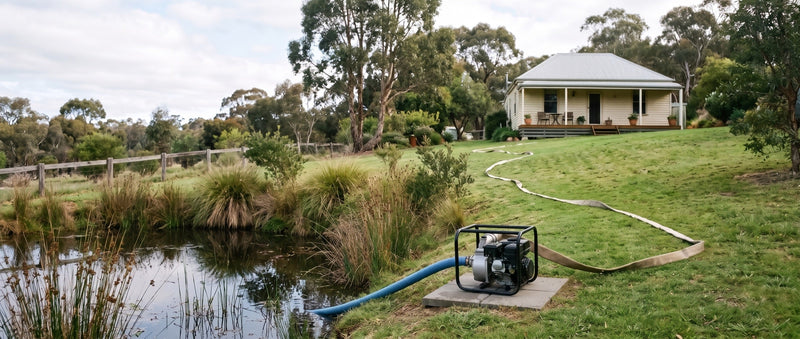
Shield it from radiant heat and keep combustibles away, whichever fuel it burns. The CFA asks for a firefighting pump protected from radiant heat. MBS 008 requires a ventilated, non-combustible cover, a hard surface and distance from hazardous vegetation. Bianco's manual adds at least 1 metre of clearance on all sides during operation and warns that the exhaust contains carbon monoxide, so the engine must run outdoors.
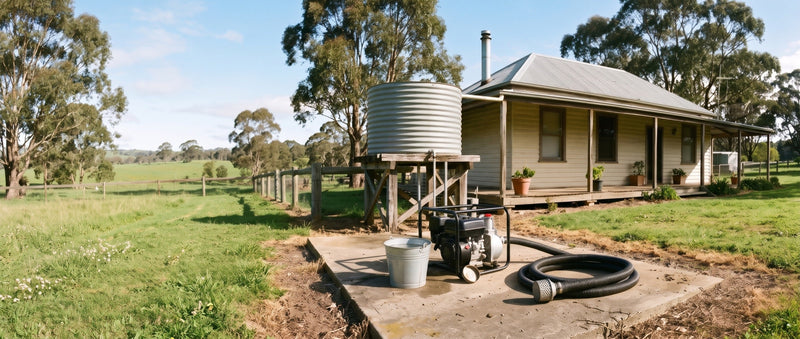
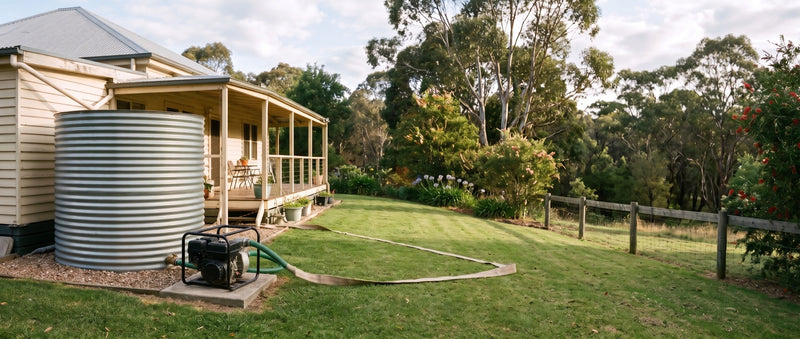
Picture a rendered brick home on a rural-residential block, with a tank beside the garage and an electric pressure pump feeding the hoses. On a high fire danger afternoon the power drops; the pressure pump stops. The hoses fall limp just as embers start landing in the gutters. A petrol fire pump, fuelled with fresh unleaded and already connected to the tank outlet, starts on the recoil and keeps water moving whatever happens to the grid. An independent engine turns a stored tank into usable water.
No pump makes staying safe. The CFA states its advice does not guarantee survival and recommends leaving the night before or early in the morning on Extreme or Catastrophic days. If the pump will also stand by during a winter burn-off, read our guide on whether you can burn off in your backyard in NSW first.
Ring me on 03 7073 2116 and tell me where the water sits, how far it must travel and whether anyone in the household would struggle with a pull start. I will say whether petrol, diesel or keeping your existing setup makes most sense. The pumps are in our fire fighting pumps collection; each carries our price-beat promise. We handle warranty for you, while delivery is charged by state at checkout, or quoted to your address for the diesel.

 Water Pumps
 Water Pumps
 Water Pumps

Want a written quote?
Tell me what you are after. I send it the same business day.
Great customer service - they rang me to tell me exactly when my bbq was coming, they also sent over the instructions and price honoured me. 10/10.
Great table delivered quickly! Very happy
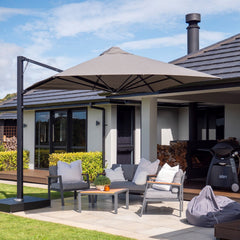
We recently had a Serenity Cantilever umbrella installed and the My Acre team were fabulous. From initially advising us what would suit our tricky terrace best, to keeping us informed on delivery and installation and ...
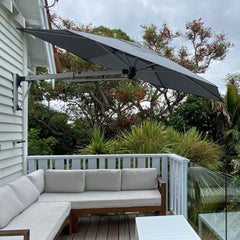
Really happy with my Shadowspec Retreat wall-mounted umbrella. Hayden at My Acre has been great — always quick to respond and very helpful. I recently needed to make a small warranty claim, and Hayden organised everyt...
Thanks to the My Acre team delighted with the end product of the Umbrella cantilever shade. In all respects Hayden was fantastic details, invoicing, adjusting delivery to suit us and supporting the installation with a...
Australian owned · every order personally followed up