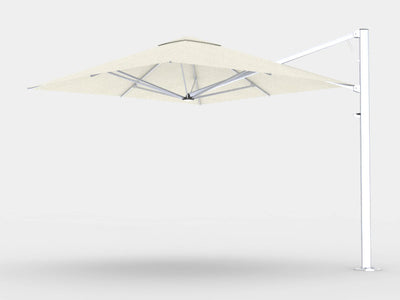
Short answer: A cantilever umbrella needs three clearances, not one. A 3.0 m Shadowspec Serenity sweeps a circle 5,946 mm across as it rotates, stands 2,908 mm to the top of its mast cap, and gives 2,054 mm of head height under the open canopy. The rotation circle is the number that catches people out, because it is roughly double the canopy size.
Most shade advice online says "allow enough room to open and rotate", which is true and useless. The manufacturers publish the exact figures for every model they build, so the rest of this page turns those figures into floor space, ceiling height and the room a closed umbrella needs before it will fold.
How much floor space does the rotation need?
A circle with a radius equal to the published mast-to-canopy-edge distance, which is a good deal larger than the canopy itself and larger again than most people allow for when they choose a cantilever umbrella.
On a Shadowspec Serenity and every other cantilever, the mast sits outside the canopy, so the canopy swings around the mast rather than spinning on its own centre. Shadowspec publishes that offset on every Serenity spec table as "centre of spigot to outside edge of canopy". Double it and you have the diameter of the circle the canopy sweeps through in a full 360 degree rotation.
| Umbrella |
Mast to canopy edge |
Swept circle |
Clear floor area needed |
| Serenity or Unity 2.5 m |
2,646 mm |
5,292 mm |
22.0 m² |
| Serenity or Unity 3.0 m |
2,973 mm |
5,946 mm |
27.8 m² |
| Serenity or Unity 3.5 m |
3,447 mm |
6,894 mm |
37.3 m² |
| Serenity or Unity 4.0 m |
3,923 mm |
7,846 mm |
48.3 m² |
| SU4 3.0 m square |
3,353 mm |
6,706 mm |
35.3 m² |
| SU4 3.5 m octagon |
3,582 mm |
7,164 mm |
40.3 m² |
Those swept diameters are not our estimate. Shadowspec's own Unity spec table gives the edge-to-edge width of a duo or quattro configuration, where two canopies sit back to back across the mast, as 5,292 mm, 5,946 mm, 6,894 mm and 7,846 mm at the four sizes. Those are precisely the diameters in the table above, which is how we checked the arithmetic against the maker's own published figure before putting it in front of anyone.
The comparison worth noticing is the SU4. A 3.0 m square SU4 canopy is the same size as a 3.0 m square Serenity canopy, yet the SU4 sweeps 6,706 mm against the Serenity's 5,946 mm, a difference of 760 mm. Canopy size alone does not tell you how much courtyard an umbrella consumes; the mast offset does.
Picture a rear courtyard in Melbourne, 4 m from the back door to the Colorbond fence, freshly paved. A 3.5 m canopy sounds like a comfortable fit for a 4 m space, so that is what gets ordered. It opens beautifully and shades the table at midday, then jams against the fence capping at about a quarter turn. The 3.5 m Serenity needs 6,894 mm of clear diameter; the courtyard offers 4,000 mm. The umbrella still works perfectly well in that position; it has simply become an expensive fixed canopy that happens to point one way. A 2.5 m in the same courtyard turns freely and follows the sun all afternoon, which is the whole point of buying a cantilever.
How much height do you need to open one?
Roughly 2.9 metres to 3.2 metres, depending on the mounting method chosen at installation.
Every Serenity and Unity cantilever umbrella, at all four canopy sizes, stands 2,908 mm to the top of its mast cap. The mounting method changes that figure in one direction only:
-
Surface plate: add 12 mm, giving 2,920 mm
-
Free-standing base: add 165 mm, giving 3,073 mm
-
Free-standing base with castor wheels: add a further 45 mm to 80 mm, giving 3,118 mm to 3,153 mm
That matters most under an existing structure. A pergola beam, a shade sail edge, a first-floor balcony or a low eave at 3 metres will foul a free-standing Serenity, even though the umbrella looks like it fits while it is closed. Check the height above the spot where the mast will actually stand, not the height at the middle of the space.
Head clearance under the open canopy is the friendlier number. On a Serenity the central frame hub sits between 2,054 mm and 2,205 mm off the ground, with the canopy edge between 2,172 mm and 2,237 mm, which lets a standing adult pass underneath without ducking at any size in the range.
Does a closed umbrella need more room than an open one?
On a centre-pole umbrella, yes, by a margin most buyers never think to check; on a cantilever umbrella, no.
The Shadowspec SU10 uses a telescopic mast that rises as the canopy closes. Its published spec table gives an overall height of 2,870 mm open and 3,740 mm closed on the 4.0 m square, and 3,120 mm open against 4,280 mm closed on the 5.0 m. The 5.0 m therefore needs 1,160 mm more vertical room to close than to stand open.
The payoff for that design is at ground level. The SU10's closed canopy clearance is 900 mm on the 4.0 m and 730 mm on the 5.0 m, which puts the closed canopy at or below the height of a standard dining table, so nobody has to shift furniture before packing up.
Cantilever umbrellas behave the opposite way. The Serenity's central frame hub drops to between 620 mm and 1,079 mm off the ground when closed, so the folded canopy hangs low beside the mast rather than climbing above it. A cantilever needs its spare room at ground level while a centre pole needs it overhead, which is why the same low pergola can comfortably suit one model and rule out the other.
What clearance do you need beside the mast?
Enough clearance for the strut arms to drop as the canopy folds. That is a published figure on the offset cantilever umbrella models, not something to estimate at installation.
Shadowspec's SU4 spec table lists the clearance of the closed strut arms at 483 mm on the 3.0 m square and 864 mm on the 3.5 m octagon, with the depth of the closed umbrella at 508 mm on both. Set an SU4 mast 300 mm from a rendered wall and the closed arms will find that wall every time.
Wall-mounted umbrellas invert the whole problem. The Shadowspec Retreat closes to a depth of 300 mm and a width of 130 mm to 150 mm against its bracket, reaching 2,609 mm out from the wall when open, or 3,065 mm with the extension run right out. Closed, it occupies a strip of wall roughly the size of a downpipe.
One caveat applies to every height figure on this page: all of them describe a level canopy. An SU4 offers a tilt from level to near vertical, and that tilt drops the leading edge well below the published head clearance while pushing it further out from the mast. If a tilting model is going in near a walkway or a fence, work from the tilted position rather than the specification table.
What if the space is smaller than the numbers?
Buy a smaller canopy, or a different type of outdoor umbrella altogether. A cantilever umbrella that cannot complete its rotation has lost the one feature you paid the premium for.
This is the point where we talk people down rather than up. A 4.0 m Serenity wants 48.3 m² of clear floor to turn in freely, which is larger than a great many Australian courtyards; the honest recommendation in that case is a 2.5 m or a 3.0 m canopy. If even 22 m² of clear space is not available, the wall-mounted Shadowspec Retreat covers the same seating from a bracket. Its installation costs considerably less than the cantilever umbrella it replaces.
Two other options are worth naming. A cantilever set at the edge of a deck can rotate through the open side and never be turned toward the house. That trades some of the 360 degrees for a much smaller footprint. The Shadowspec Unity puts two, three or four canopies on one mast, covering a rectangle without the swept circle a single larger umbrella would need. Measure your clear paving first, then choose the canopy. Ring me on 1300 515 620 with the dimensions and I will tell you which size fits, including the times when the answer is the cheaper one.
The verdict
A cantilever umbrella needs its swept circle before anything else: 5,946 mm across for a 3.0 m Serenity, 7,846 mm for a 4.0 m, 6,706 mm for a 3.0 m SU4. Then confirm at least 2,908 mm of vertical room, or 3,073 mm on a free-standing base, and leave the closed arms somewhere to go.
The exception is a fixed-position installation where the umbrella is never rotated. There the canopy footprint is all that matters, though you have given up the reason most people choose a cantilever umbrella in the first place.
Browse the cantilever umbrellas and the wall umbrellas, then ring before ordering. A price-beat promise on anything you find cheaper elsewhere; we handle any warranty claim for you rather than sending you back to the maker.
You may also like
About the author:
“I have a real passion for helping transform outdoor spaces so people can relax, connect and entertain with confidence and pride. With My Acre, I love guiding homeowners to create beautiful and functional outdoor living areas."