
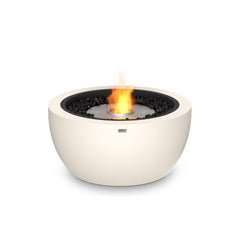
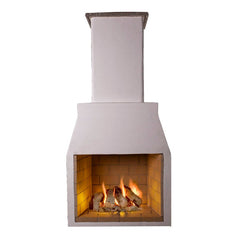
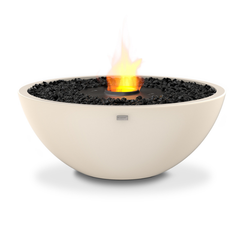
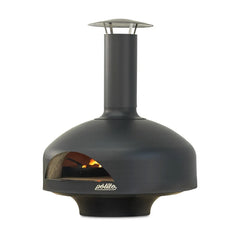

A bioethanol fire gives you a living flame with no flue, no gas line and no gasfitter. Here is the honest cost against gas, in Australian dollars, with a calculator to run your own.

Cheaper to own, not cheaper by the hour.
Gas buys a cheaper hour of flame, but it takes years of steady fires to earn back its install. A bioethanol fire asks for nothing up front, and nothing in the quiet months when it sits unused. The less you burn it, the further ahead it stays.
Running-cost calculator
Is bioethanol cheaper to run than gas?
The only bioethanol running-cost calculator in Australia. It reads each fire's own burner, so the numbers change with the model you pick.
Burn rates are EcoSmart's tested figures for each burner; fuel at $6.88/L delivered ($275 for 40 L). Costs shown as ranges. Cool 60 minutes before refuelling.
Side by side
Ethanol vs gas, at a glance
The fuel row and totals below follow the fire you chose in the calculator.
| EcoSmart bioethanol | Installed gas fire | |
|---|---|---|
| Installation | ✓$0, unbox and light | $2,000 to $7,500; built-in $3,500 to $15,000+ |
| Flue or gas line | ✓None | Required; a new gas line adds $500 to $2,000 |
| Gasfitter & certificate | ✓Not needed | Required by law, about $800 to $1,500 |
| Yearly service | ✓None | $150 to $300 |
| Standing charges | ✓None when it is off | Daily supply charge, all year |
| Fuel, your evening | – | ✓– |
| Take it with you | ✓Yes, freestanding | Fixed where it was plumbed |
How it works
Do bioethanol fireplaces give off as much heat as gas?
A bioethanol fire keeps over 90% of its heat in the room, where a flued gas or wood fire loses about 30% up the chimney. e-NRG bioethanol is a plant-based alcohol that burns to heat, steam and a little carbon dioxide. No smoke, no soot, no flue.
Pour
Fill the Grade 304 stainless burner. One fill holds a full evening and more.
Light
Ignite with the lighting rod. A living flame in seconds, warmth for the room.
Slide to close
Slide the lid to snuff it. Cool 60 minutes before refuelling, with the safety nozzle.
Is it safe indoors? What about ventilation?
Yes, when used as intended. EcoSmart burners meet Australia's ACCC safety mandate for decorative ethanol devices. Because the flame uses a little oxygen and gives off water vapour, match the burner to a well-ventilated room of the right size; EcoSmart publishes a minimum room volume for each model. Refuel only when cool, using the safety nozzle, never poured straight from the bottle, and only with e-NRG.
How much heat does it really give?
A large AB8 burner puts out about 6 kW and, keeping over 90% of it in the room, warms up to 60 m². The compact AB3 gives about 2 kW for rooms near 20 m². Multi-burner fire pit kits reach 9 to 13 kW. It is a feature fire and zone warmth, not whole-home heating.
Indoors or out
One flame, wherever you gather.
Freestanding tables and pits, or a built-in fire pit kit dropped into your own bench or table. No flue means it goes where a gas fire cannot.

Indoors
A real flame for the living room, no chimney and no permit fuss. Ventless by design, it suits apartments and renovations.

Outdoors
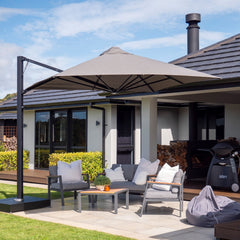
Fire tables, fire pits and built-in fire pit kits for the deck and alfresco. Move it, or build it into stone or timber.
The range
Where to start.
Our most-loved bioethanol fires, and the fuel that runs them.


Quick answers
Common questions
Is bioethanol cheaper than gas to run?
Per hour of flame, no; mains gas is usually cheaper once installed. Ethanol is cheaper to own: $0 install, no flue, no gasfitter, no service and no supply charge. Over five years of weekend fires the ethanol fire usually costs less all in, because there is nothing to install.
How much does a bioethanol fireplace cost to run per hour?
About $6.10 to $7.80 an hour at full flame on the large AB8 burner, less with the Efficiency Ring, about $5 to $5.50 an hour on the XL900 and about $2 an hour on the compact AB3.
How long does 1 litre of bioethanol last?
About 1 to 2 hours. A full 8-litre AB8 tank burns 7 to 9 hours at full flame, or 9 to 11 with the Efficiency Ring. The 9-litre XL900 runs 8 to 13 hours.
Can I use a bioethanol fireplace indoors?
Yes. The ventless design suits living rooms, apartments and renovations. Match the burner to a well-ventilated room of the right size, keep a smoke alarm on site, and choose the indoor specification where offered.
Can I build a bioethanol fire into my own bench or table?
Yes. A Fire Pit Kit is a burner, tray and glass designed to drop into a non-combustible bench, table or surround you build, indoors or out. Our kits run from the compact Round 20 and Square 22 to the three-burner Linear 130.
Are ethanol fireplaces legal in Australia?
Yes. EcoSmart burners meet the mandatory ACCC safety standard for decorative ethanol devices, and e-NRG bottles carry the required flame arrester.
Do bioethanol fireplaces need a flue or gas line?
No. No flue, no gas line, no gasfitter, no certificate. Unbox, place, fill and light.
What are the disadvantages of a bioethanol fireplace?
Fuel costs more per hour than mains gas, the burner must cool 60 minutes before refuelling, wind speeds the burn outdoors (a glass screen steadies it), and it is a feature fire, not whole-home heating.
Which is better for me, ethanol or gas?
Nightly, all-year burning with a budget for installation suits gas. A real flame for the evenings you actually have, anywhere you like, with nothing to install, suits bioethanol.
So, should you choose bioethanol or gas?
Nightly, all-year burning with a budget for installation suits gas. A real flame for the evenings you actually have, with nothing to install, suits bioethanol. Still weighing it up? Talk it through with the owner.
Call 1300 515 620