Last updated: August 2026
Short answer: a basic DIY fire pit is a weekend job. Lay a ring of retaining-wall or besser blocks on a level gravel base, put a layer of gravel or lava rock in the bottom for drainage, and keep well clear of the house, fences and anything overhead. Check your council's rules and any total fire ban first. If you would rather skip the build and the smoke, a bought bioethanol fire pit lights in seconds, makes no smoke and can move with you.
Building your own fire pit is one of the cheapest ways to add a real flame to a backyard, and for a lot of Australian homes a stacked-block pit does the job for a couple of hundred dollars. This guide covers the rules, the cheapest way to build one, what goes in the bottom, and an honest look at when buying a finished pit is the smarter call. See the full range on the ethanol fire pits page if you decide building is not for you.
Are fire pits legal in Australia?
Fire pits are legal in most of Australia, but the rules are set by your local council, not nationally, so you must check yours before you light one. Many councils allow a domestic fire pit for warmth or cooking if it uses dry, seasoned wood and does not create a smoke nuisance for neighbours; some require it to be a set distance from boundaries and buildings. On a declared total fire ban day, an open fire pit is banned regardless of council rules. Check your council website and the CFA, RFS or your state fire authority for total fire ban days before every burn.
What is the cheapest way to build a fire pit?
The cheapest fire pit is a ring of concrete blocks on a level base, and you can build one for roughly $100 to $300 in materials. Retaining-wall blocks or standard besser blocks stacked two or three courses high make a sturdy wall; a round steel wood-heater insert or a simple in-ground design costs even less. Spending more buys a neater finish (capping pavers, fire brick lining) and longer life, but none of it changes how the fire performs.
-
Cheapest: an in-ground pit or a single ring of blocks, $50 to $150
-
Most common: a stacked besser or retaining-wall block ring with a gravel base, $150 to $300
-
Neater and longer-lasting: block ring with fire-brick lining and capping pavers, $300 to $600
Can I just dig a hole for a fire pit?
Yes, an in-ground fire pit is the simplest DIY option, but dig it right. Make it about 300 to 450mm deep and 600 to 900mm wide, line the base with a layer of gravel or sand for drainage so water does not pool, and ring the rim with rocks or pavers to contain the fire and mark the edge. Keep it well away from tree roots, irrigation and services, and never dig a pit under a deck, pergola or overhanging branches.
What should you put in the bottom of a fire pit?
Put a 100 to 150mm layer of gravel, coarse sand or lava rock in the bottom of a fire pit. That layer drains rainwater, protects the base from direct heat and lets air move under the fire. Avoid smooth river rocks or any wet, porous stone: trapped moisture turns to steam as they heat and they can crack or burst. Lava rock and rated fire-pit gravel are made for the job and will not spit.
How to build a besser block fire pit
A stacked-block fire pit is the most popular DIY build because it needs no mortar and no special tools. The steps below produce a solid, round pit about 900mm across.
- Choose a level, open spot on a non-combustible base (paving, gravel or bare soil), well clear of the house, fences and anything overhead.
- Mark a circle about 900mm across. Skim off the grass and level the ground, then spread a 50 to 75mm bed of road base or gravel and compact it flat.
- Lay the first ring of retaining-wall or besser blocks around the circle, checking each is level. Trapezoidal retaining blocks curve neatly; square blocks leave small gaps that are fine for airflow.
- Stack a second and third course, staggering the joins like brickwork so the wall is stable. Two to three courses is plenty.
- Add a 100 to 150mm layer of gravel or lava rock in the bottom for drainage.
- Optionally cap the top course with pavers for a finished edge and a ledge to rest a grill or drinks on.
Clearances and safety
Keep a DIY fire pit at least 3 metres from the house, fences, sheds and anything that can burn, with nothing overhanging it. Sit it on a non-combustible base, never on a timber deck or directly on dry grass. Burn only dry, seasoned hardwood, never treated timber, pallets or rubbish, which give off toxic smoke. Keep a bucket of water or a hose and a fire blanket within reach, never leave the fire unattended, and let the ash cool fully before you clear it. On a timber deck or a covered area, a masonry pit is the wrong tool; see will a fire pit damage a composite deck for the safer options.
When buying beats building
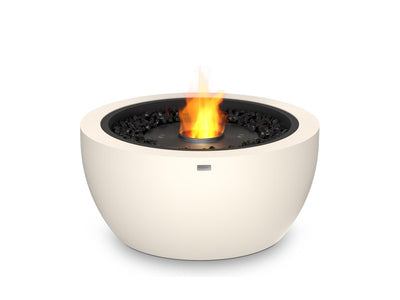
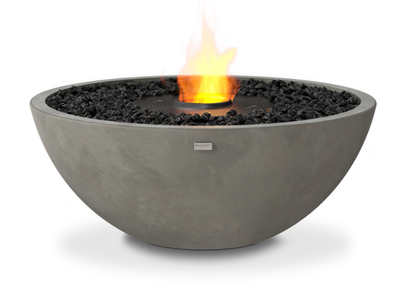
Building is cheapest, but a bought fire pit wins on three things a DIY build cannot easily give you: no smoke, no digging, and the freedom to move it. A bioethanol fire pit burns clean liquid fuel with no smoke, soot or ash, so there is no smoke to bother the neighbours. It is still a fire in the open, so it cannot be lit outdoors on a total fire ban day. Several EcoSmart models can also come indoors, with the accessories and room size EcoSmart specify. It lights in seconds with a slider to put it out, and it sits on a deck, balcony or courtyard where a masonry pit would never be allowed.
If a smokeless, moveable, no-build flame suits your space better than a weekend of block-stacking, browse the ethanol fire pit range, or call us on 1300 515 620 and we will help you pick the right size.
Frequently asked questions
Do I need council approval for a backyard fire pit?
Usually not for a small, moveable domestic fire pit, but it depends on your council and whether the pit is a fixed structure. Check your local council rules for size, boundary distances and smoke, and never light one on a total fire ban day.
What should you put in the bottom of a fire pit?
A 100 to 150mm layer of gravel, coarse sand or lava rock. It drains rainwater and protects the base from heat. Avoid smooth river rocks or wet stone, which can crack or burst as trapped moisture turns to steam.
How far should a fire pit be from the house?
At least 3 metres from the house, fences, sheds and anything that can burn, with clear sky above it. Sit it on a non-combustible base and never on a timber deck or dry grass.
Is a DIY fire pit cheaper than buying one?
Yes, a stacked-block pit costs roughly $100 to $300 in materials. A bought fire pit costs more but adds no smoke, no digging and the freedom to move it, and a bioethanol model can be used on a deck. An indoor-rated one can come inside once EcoSmart's Indoor Safety Tray (sold separately) is fitted, with the Efficiency Ring on AB8 burners, in a room that meets EcoSmart's minimum size for that burner.
You may also like