Short answer: Burn wood under 25% moisture, ideally between 12% and 20%, seasoned for six to twelve months after splitting. In South Australia, Victoria and southern New South Wales that means River Red Gum; in Queensland, Ironbark or Box; in Western Australia, Jarrah or Wandoo. Skip anything treated, painted or salvaged from old rail sleepers, since the fumes can be harmful or worse.
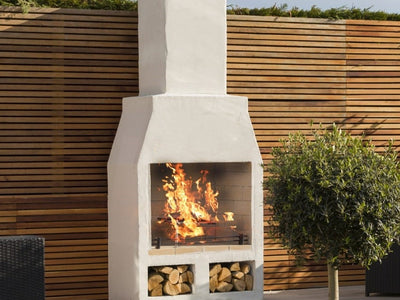
This applies to a genuine open wood flame, the kind My Acre's Ochre Living range is built around, rather than a bioethanol or gas fire feature. Here's what to feed it.
How dry is dry enough
The Firewood Association of Australia sets the working threshold at under 25% moisture, with 12% to 20% as the sweet spot most seasoned wood eventually settles into. Green wood, cross-cut into 300 mm rounds, takes approximately six to twelve months to drop below that line. A Log Store filled in autumn, in other words, is aimed at next winter's burns, not this one's.
Wood that's still green burns cooler and smokier. In Ochre Living's Ossa, Hotham or Perisher, all of which run a real chimney rather than an open pit, that unburnt smoke is exactly what turns into creosote build-up further up the flue.
The species that actually suit an open flame
The FAA names River Red Gum as the standout across South Australia, Victoria and southern New South Wales; further north in Queensland, the recommended choice is Ironbark or Box. There's a catch worth knowing before you buy a trailer load. Red Gum burns hot in a slow combustion heater but produces comparatively little visible flame, so it suits an enclosed unit better than an open firebox where the flame itself is half the point.
Turpentine and White Stringybark sit at the other end, named by the FAA as species that don't burn well at all, regardless of how dry they are.
What not to burn
Chemically treated, painted or preserved timber can release fumes that are harmful or fatal when burned in an open fire, a brazier or a chiminea. Old rail sleepers are the clearest example. Decades of grease, oil, herbicide and heavy-metal contamination sit alongside them routinely, sometimes asbestos from pre-1980s brake linings, and the odd embedded stone capable of exploding in the heat. None of it is worth the free firewood.
The honest verdict
Season it properly, pick a species suited to an open flame rather than a heater, and leave anything treated at the tip. Every Ochre Living fireplace ordered through My Acre carries our price-beat promise, with delivery priced by state. Hayden checks in within the week to make sure it's drawing properly, warranty handled by us if it ever needs it. Browse Ochre Living for the fireplace itself, or get a quote and Hayden will talk you through which model suits your entertaining space.
You May Also Like:
About the author:
“I have a real passion for helping transform outdoor spaces so people can relax, connect and entertain with confidence and pride. With My Acre, I love guiding homeowners to create beautiful and functional outdoor living areas."